从零实现 LLM Inference:019. Paged Attention
在加完 pytorch profiler 之后,顺手做了两个小优化,比如减少 cat 和 slice 的次数,但是这些终究是小打小闹,在本次改动中,我们真正来实现一下 paged attention。
首先我们把 kv block 的管理给换掉,之前我们每一个 kv block id 要对应单独的 tensor,现在我们预先分配好一个大 tensor,后续所有的 kv block 都是直接在这个大 tensor 上的 slice:
diff --git a/rosellm/roseinfer/engine.py b/rosellm/roseinfer/engine.py
index 805581c..c2f69de 100644
--- a/rosellm/roseinfer/engine.py
+++ b/rosellm/roseinfer/engine.py
@@ -1337,10 +1337,12 @@ class KVBlockManager:
         self._next_block_index: list[int] = [0 for _ in range(num_layers)]
         self._free_block_indices: list[list[int]] = [[] for _ in range(num_layers)]
         self._block_infos: dict[int, KVBlockInfo] = {}
-        self._block_storage: dict[
-            int,
-            tuple[torch.Tensor, torch.Tensor],
-        ] = {}  # global_id -> (key_block, value_block)
+        self._k_cache = torch.empty(
+            (num_layers, max_blocks_per_layer, num_heads, block_size, head_dim),
+            device=device,
+            dtype=dtype,
+        )
+        self._v_cache = torch.empty_like(self._k_cache)
         self._block_refcounts: dict[int, int] = {}

     def _alloc_block_index(self, layer_idx: int) -> int:
@@ -1363,7 +1365,7 @@ class KVBlockManager:
     def register_prefill_layer(
         self,
         layer_idx: int,
-        key: torch.Tensor,  # [1, H, D, T]
+        key: torch.Tensor,  # [1, H, T, D]
         value: torch.Tensor,
     ) -> list[int]:
         assert 0 <= layer_idx < self.num_layers
@@ -1389,19 +1391,8 @@ class KVBlockManager:
                 length=length,
             )
             self._block_infos[global_id] = info
-            k_block = torch.zeros(
-                (
-                    self.num_heads,
-                    block_size,
-                    self.head_dim,
-                ),
-                dtype=self.dtype,
-                device=self.device,
-            )
-            v_block = torch.zeros_like(k_block)
-            k_block[:, :length, :] = k_slice[0]
-            v_block[:, :length, :] = v_slice[0]
-            self._block_storage[global_id] = (k_block, v_block)
+            self._k_cache[layer_idx, block_idx, :, :length, :].copy_(k_slice[0])
+            self._v_cache[layer_idx, block_idx, :, :length, :].copy_(v_slice[0])
             self._block_refcounts[global_id] = 1
             block_ids.append(global_id)
         return block_ids
@@ -1440,7 +1431,6 @@ class KVBlockManager:
             self._free_block_indices[layer_idx].append(
                 info.block_index,
             )
-            self._block_storage.pop(global_id, None)

     def append_token(
         self,
@@ -1463,17 +1453,6 @@ class KVBlockManager:
                 length=0,
             )
             self._block_infos[global_id] = info
-            k_block = torch.zeros(
-                (
-                    self.num_heads,
-                    self.block_size,
-                    self.head_dim,
-                ),
-                dtype=self.dtype,
-                device=self.device,
-            )
-            v_block = torch.zeros_like(k_block)
-            self._block_storage[global_id] = (k_block, v_block)
             self._block_refcounts[global_id] = 1
             block_ids.append(global_id)
         last_id = block_ids[-1]
@@ -1493,10 +1472,14 @@ class KVBlockManager:
                 length=info.length,
             )
             self._block_infos[new_global_id] = new_info
-            k_block_old, v_block_old = self._block_storage[last_id]
-            k_block = k_block_old.clone()
-            v_block = v_block_old.clone()
-            self._block_storage[new_global_id] = (k_block, v_block)
+            self._k_cache[
+                layer_idx,
+                block_idx,
+            ].copy_(self._k_cache[layer_idx, info.block_index])
+            self._v_cache[
+                layer_idx,
+                block_idx,
+            ].copy_(self._v_cache[layer_idx, info.block_index])
             self._block_refcounts[new_global_id] = 1
             block_ids[-1] = new_global_id
             last_id = new_global_id
@@ -1511,25 +1494,15 @@ class KVBlockManager:
                 length=0,
             )
             self._block_infos[global_id] = info
-            k_block = torch.zeros(
-                (
-                    self.num_heads,
-                    self.block_size,
-                    self.head_dim,
-                ),
-                dtype=self.dtype,
-                device=self.device,
-            )
-            v_block = torch.zeros_like(k_block)
-            self._block_storage[global_id] = (k_block, v_block)
             self._block_refcounts[global_id] = 1
             block_ids.append(global_id)
             last_id = global_id
         info = self._block_infos[last_id]
-        k_block, v_block = self._block_storage[last_id]
+        k_block = self._k_cache[layer_idx, info.block_index]
+        v_block = self._v_cache[layer_idx, info.block_index]
         pos = info.length
-        k_block[:, pos, :] = key_new
-        v_block[:, pos, :] = value_new
+        k_block[:, pos, :].copy_(key_new)
+        v_block[:, pos, :].copy_(value_new)
         new_info = KVBlockInfo(
             layer=info.layer,
             block_index=info.block_index,
@@ -1559,9 +1532,10 @@ class KVBlockManager:
             take = end - cur
             if take <= 0:
                 break
-            k_block, v_block = self._block_storage[global_id]
-            out_k[:, cur:end, :] = k_block[:, :take, :]
-            out_v[:, cur:end, :] = v_block[:, :take, :]
+            k_block = self._k_cache[layer_idx, info.block_index]
+            v_block = self._v_cache[layer_idx, info.block_index]
+            out_k[:, cur:end, :].copy_(k_block[:, :take, :])
+            out_v[:, cur:end, :].copy_(v_block[:, :take, :])
             cur = end
             if cur >= total_len:
                 break
运行一下 benchmark 看看:
(/data/projects/rosellm/.conda) wine@wine-MS-7D90:/data/projects/rosellm$ python -m rosellm.roseinfer.benchmark_scheduler   --checkpoint-path rosellm/rosetrainer/checkpoints/gpt2_small_ddp_edu_amp_bf16_init.pt   --tokenizer-name gpt2   --device cuda   --prompt "Hello"   --num-requests 16   --max-new-tokens 16   --mode online   --do-sample   --top-k 40   --top-p 0.9 --no-stop-on-eos  --profile
=== online ===
Requests: 16
Elapsed (prefill/add): 0.177873 seconds
Elapsed (decode/run): 0.426553 seconds
Elapsed (total): 0.604426 seconds
Prompt tokens: 16
Completion tokens: 256
Total tokens: 272
Throughput (completion): 423.54 tokens/s
Throughput (total): 450.01 tokens/s

[profile] wrote: profiles/online_decode.json
接下来我们实现真正的 paged attention,先用纯 pytorch 实现,后续再迁移到 triton / cuda,本次我们先只实现 decode step 时的 paged attention,因为 prefill 时的 paged attention 还要更加复杂。
paged attention 本质实际上是是依次拿 kv blocks 做一个 online attention(online softmax)。
有一个很好地可以用来理解 online attention 的纯 python 代码:
import math

def online_attention(q, ks, vs, scale):
    # q: [D]
    # ks: list of [D]
    # vs: list of [D]
    # returns out: [D]
    # init using first element to avoid empty
    s0 = sum(q[i] * ks[0][i] for i in range(len(q))) * scale
    m = s0
    l = 1.0
    acc = vs[0][:]

    for k, v in zip(ks[1:], vs[1:]):
        s = sum(q[i] * k[i] for i in range(len(q))) * scale
        m_new = max(m, s)

        exp_scale_old = math.exp(m - m_new)
        exp_s = math.exp(s - m_new)

        l = l * exp_scale_old + exp_s
        acc = [a * exp_scale_old + exp_s * vv for a, vv in zip(acc, v)]
        m = m_new

    return [a / l for a in acc]
在全程主要就是维护三个变量:
- m 表示 score 的最大值,用来做 softmax 的稳定版实现,也就是 exp 里面减掉所有值的最大值那个
- l 表示 softmax 分母上的那个 exp 求和,也是带了减去所有值的最大值的那个逻辑的
- acc 表示 softmax 分子上的那个用了 score 做权重的加权 exp 求和,也是带了减去所有值的最大值的那个逻辑的
然后我们可以有一个 pytorch 以及 triton 的实现:
from __future__ import annotations

from dataclasses import dataclass

import torch

try:
    import triton
    import triton.language as tl
except ImportError:  # pragma: no cover
    triton = None  # type: ignore[assignment]
    tl = None  # type: ignore[assignment]

TRITON_AVAILABLE = triton is not None


@dataclass(frozen=True)
class PagedKVCache:
    k_cache: torch.Tensor
    v_cache: torch.Tensor
    block_tables: list[torch.Tensor]
    context_lens: torch.Tensor
    block_size: int


def paged_attention_decode_ref(
    q: torch.Tensor,  # [B, H, D]
    k_new: torch.Tensor,  # [B, H, D]
    v_new: torch.Tensor,  # [B, H, D]
    k_cache_layer: torch.Tensor,  # [N_BLOCKS, H, BS, D]
    v_cache_layer: torch.Tensor,  # [N_BLOCKS, H, BS, D], BS: block size
    block_table: torch.Tensor,  # [B, N_LOGICAL_BLOCKS]
    context_lens: torch.Tensor,  # [B]
    *,
    scale: float,
    block_size: int,
) -> torch.Tensor:  # [B, H, D]
    assert q.dim() == 3
    assert q.shape == k_new.shape == v_new.shape
    assert k_cache_layer.dim() == 4 and v_cache_layer.dim() == 4
    assert block_table.dim() == 2
    assert context_lens.dim() == 1
    assert k_cache_layer.size(2) == block_size
    device = q.device
    bsz, n_heads, head_dim = q.shape
    num_blocks = block_table.size(1)
    q_f = q.float()
    k_new_f = k_new.float()  # [B, H, D]
    v_new_f = v_new.float()  # [B, H, D]
    scores_cur = (q_f * k_new_f).sum(dim=-1) * scale  # [B, H]
    # m: max logits so far, [B, H]
    m = scores_cur
    # l: exp-sum, [B, H]
    l = torch.ones((bsz, n_heads), device=device, dtype=torch.float32)
    # o: weighted sum, [B, H, D]
    o = v_new_f
    pos = torch.arange(block_size, device=device).view(1, 1, block_size)
    for logical_block in range(num_blocks):
        block_ids = block_table[:, logical_block]  # [B]
        k_blk = k_cache_layer[block_ids].float()  # [B, H, BS, D]
        v_blk = v_cache_layer[block_ids].float()  # [B, H, BS, D]
        start = logical_block * block_size
        valid = (context_lens - start).clamp(min=0, max=block_size)  # [B]
        mask = pos < valid.view(bsz, 1, 1)  # [B, 1, BS] -> broadcast on head dim
        scores = torch.einsum("bhd,bhtd->bht", q_f, k_blk) * scale
        scores = scores.masked_fill(~mask, -float("inf"))  # [B, H, BS]
        m_ij = scores.max(dim=-1).values  # [B, H]
        m_new = torch.maximum(m, m_ij)  # [B, H]
        exp_scale_old = torch.exp(m - m_new)  # [B, H]
        exp_scores = torch.exp(scores - m_new.unsqueeze(-1))  # [B, H, BS]
        l = l * exp_scale_old + exp_scores.sum(dim=-1)  # [B, H]
        o = o * exp_scale_old.unsqueeze(-1) + torch.einsum(
            "bht,bhtd->bhd", exp_scores, v_blk
        )
        m = m_new
    out = (o / l.unsqueeze(-1)).to(dtype=q.dtype)  # [B, H, D]
    return out


if TRITON_AVAILABLE:

    @triton.jit
    def _paged_attn_decode_kernel(
        out_ptr,
        q_ptr,
        k_new_ptr,
        v_new_ptr,
        k_cache_ptr,
        v_cache_ptr,
        block_table_ptr,
        context_lens_ptr,
        stride_kcb: tl.constexpr,
        stride_kch: tl.constexpr,
        stride_kct: tl.constexpr,
        stride_kcd: tl.constexpr,
        stride_vcb: tl.constexpr,
        stride_vch: tl.constexpr,
        stride_vct: tl.constexpr,
        stride_vcd: tl.constexpr,
        scale: tl.constexpr,
        H: tl.constexpr,
        D: tl.constexpr,
        BLOCK_SIZE: tl.constexpr,
        MAX_BLOCKS: tl.constexpr,
    ):
        pid = tl.program_id(0)
        b = pid // H
        h = pid % H
        d = tl.arange(0, D)
        base = (b * H + h) * D + d
        q = tl.load(q_ptr + base, mask=d < D, other=0.0).to(tl.float32)
        k_new = tl.load(k_new_ptr + base, mask=d < D, other=0.0).to(tl.float32)
        v_new = tl.load(v_new_ptr + base, mask=d < D, other=0.0).to(tl.float32)
        score_cur = tl.sum(q * k_new, axis=0) * scale
        m = score_cur
        l = 1.0
        acc = v_new
        context_len = tl.load(context_lens_ptr + b).to(tl.int32)
        t = tl.arange(0, BLOCK_SIZE)
        for lb in tl.static_range(0, MAX_BLOCKS):
            start = lb * BLOCK_SIZE
            tok_pos = start + t
            tok_mask = tok_pos < context_len
            has_any = start < context_len
            block_id = tl.load(
                block_table_ptr + b * MAX_BLOCKS + lb,
                mask=has_any,
                other=0,
            ).to(tl.int32)
            k_ptrs = (
                k_cache_ptr
                + block_id * stride_kcb
                + h * stride_kch
                + t[:, None] * stride_kct
                + d[None, :] * stride_kcd
            )
            v_ptrs = (
                v_cache_ptr
                + block_id * stride_vcb
                + h * stride_vch
                + t[:, None] * stride_vct
                + d[None, :] * stride_vcd
            )
            k = tl.load(
                k_ptrs,
                mask=tok_mask[:, None] & (d[None, :] < D),
                other=0.0,
            ).to(tl.float32)
            v = tl.load(
                v_ptrs,
                mask=tok_mask[:, None] & (d[None, :] < D),
                other=0.0,
            ).to(tl.float32)
            scores = tl.sum(k * q[None, :], axis=1) * scale
            scores = tl.where(tok_mask, scores, -float("inf"))
            m_ij = tl.max(scores, axis=0)
            m_new = tl.maximum(m, m_ij)
            exp_scale_old = tl.exp(m - m_new)
            exp_scores = tl.exp(scores - m_new)
            l = l * exp_scale_old + tl.sum(exp_scores, axis=0)
            acc = acc * exp_scale_old + tl.sum(exp_scores[:, None] * v, axis=0)
            m = m_new
        out = acc / l
        tl.store(out_ptr + base, out, mask=d < D)


def paged_attention_decode_triton(
    q: torch.Tensor,  # [B, H, D]
    k_new: torch.Tensor,  # [B, H, D]
    v_new: torch.Tensor,  # [B, H, D]
    k_cache_layer: torch.Tensor,  # [N_BLOCKS, H, BS, D]
    v_cache_layer: torch.Tensor,  # [N_BLOCKS, H, BS, D]
    block_table: torch.Tensor,  # [B, MAX_BLOCKS] int32 cuda
    context_lens: torch.Tensor,  # [B] int32 cuda
    *,
    scale: float,
    block_size: int,
) -> torch.Tensor:  # [B, H, D]
    if not TRITON_AVAILABLE:
        raise RuntimeError(
            "paged_attention_decode_triton requires Triton; install it to use --paged-attn"
        )
    assert q.is_cuda
    q = q.contiguous()
    k_new = k_new.contiguous()
    v_new = v_new.contiguous()
    if block_table.dtype != torch.int32:
        block_table = block_table.to(torch.int32)
    if context_lens.dtype != torch.int32:
        context_lens = context_lens.to(torch.int32)
    B, H, D = q.shape
    out = torch.empty_like(q)
    grid = (B * H,)
    _paged_attn_decode_kernel[grid](
        out,
        q,
        k_new,
        v_new,
        k_cache_layer,
        v_cache_layer,
        block_table,
        context_lens,
        stride_kcb=k_cache_layer.stride(0),
        stride_kch=k_cache_layer.stride(1),
        stride_kct=k_cache_layer.stride(2),
        stride_kcd=k_cache_layer.stride(3),
        stride_vcb=v_cache_layer.stride(0),
        stride_vch=v_cache_layer.stride(1),
        stride_vct=v_cache_layer.stride(2),
        stride_vcd=v_cache_layer.stride(3),
        scale=scale,
        H=H,
        D=D,
        BLOCK_SIZE=block_size,
        MAX_BLOCKS=block_table.size(1),
        num_warps=4,
    )
    return out
然后我们在 InferenceEngine 里面加一个 use_paged_attention 的 flag,在 decode_step_sessions 方法中判断这个 flag,走 paged attention 逻辑:
            if self.use_paged_attention:
                from rosellm.rosetrainer.paged_attention import PagedKVCache

                block_size = kvm.block_size
                num_blocks_max = self.max_blocks_per_seq
                max_blocks_per_layer = kvm.max_blocks_per_layer
                block_tables_buf = self._get_paged_block_tables_buf(batch_size)
                with record_function(
                    "roseinfer.decode_step_sessions.build_block_tables",
                ):
                    block_tables: list[torch.Tensor] = []
                    for layer_idx in range(num_layers):
                        offset = layer_idx * max_blocks_per_layer
                        rows: list[list[int]] = []
                        for idx, sess in enumerate(sessions):
                            ids = sess.block_ids_per_layer[layer_idx]
                            physical = [gid - offset for gid in ids]
                            if not physical:
                                physical = [0]
                            if len(physical) < num_blocks_max:
                                physical = physical + [0] * (
                                    num_blocks_max - len(physical)
                                )
                            else:
                                physical = physical[:num_blocks_max]
                            rows.append(physical)
                        cpu_table = torch.tensor(rows, dtype=torch.int32)
                        block_table = block_tables_buf[layer_idx, :batch_size]
                        block_table.copy_(cpu_table)
                        block_tables.append(block_table)
                paged = PagedKVCache(
                    k_cache=kvm._k_cache,
                    v_cache=kvm._v_cache,
                    block_tables=block_tables,
                    context_lens=lens.to(torch.int32),
                    block_size=block_size,
                )
                with record_function(
                    "roseinfer.model.forward",
                ):
                    if self.use_amp:
                        with autocast(device_type=device.type, dtype=self.amp_dtype):
                            logits, _, presents = self.model(
                                input_ids=input_ids,
                                attention_mask=None,
                                labels=None,
                                past_key_values=None,
                                use_cache=True,
                                position_ids=position_ids,
                                paged_kv_cache=paged,
                            )
                    else:
                        logits, _, presents = self.model(
                            input_ids=input_ids,
                            attention_mask=None,
                            labels=None,
                            past_key_values=None,
                            use_cache=True,
                            position_ids=position_ids,
                            paged_kv_cache=paged,
                        )
                last_logits = logits[:, -1, :]  # [B, V]
                with record_function("roseinfer.kv.append_token"):
                    for layer_idx in range(num_layers):
                        k_step, v_step = presents[layer_idx]  # [B, H, 1, D]
                        k_step = k_step.squeeze(2)  # [B, H, D]
                        v_step = v_step.squeeze(2)
                        for idx, sess in enumerate(sessions):
                            kvm.append_token(
                                layer_idx,
                                sess.block_ids_per_layer[layer_idx],
                                k_step[idx],
                                v_step[idx],
                            )
                return last_logits
这个构造的 paged_kv_cache 也要通过 model 一路传入,传到 MHA 的实现当中去:
    def forward(
        self,
        x: torch.Tensor,
        attention_mask: Optional[torch.Tensor] = None,  # [B, T]
        past_kv: Optional[tuple[torch.Tensor, torch.Tensor]] = None,
        return_kv: bool = False,
        paged_kv_cache: Optional[PagedKVCache] = None,
        layer_idx: int = 0,
    ):
        bsz, seq_len, _ = x.size()
        qkv = self.qkv_proj(x)
        qkv = qkv.view(bsz, seq_len, 3, self.local_heads, self.d_head)
        qkv = qkv.permute(2, 0, 3, 1, 4)
        q, k, v = qkv[0], qkv[1], qkv[2]  # [B, H, T, D]
        if paged_kv_cache is not None:
            if past_kv is not None:
                raise ValueError("past_kv and paged_kv_cache cannot be used together")
            if seq_len != 1:
                raise ValueError("paged attention only supports decode(T=1)")
            out_h = paged_attention_decode(
                q=q.squeeze(-2),  # [B, H, D]
                k_new=k.squeeze(-2),  # [B, H, D]
                v_new=v.squeeze(-2),
                k_cache_layer=paged_kv_cache.k_cache[layer_idx],
                v_cache_layer=paged_kv_cache.v_cache[layer_idx],
                block_table=paged_kv_cache.block_tables[layer_idx],
                context_lens=paged_kv_cache.context_lens,
                scale=self.d_head**-0.5,
                block_size=paged_kv_cache.block_size,
            )  # [B, H, D]
            attn_output = out_h.unsqueeze(2)  # [B, H, 1, D]
            # [B, 1, H, D]
            attn_output = attn_output.transpose(1, 2).contiguous()
            attn_output = attn_output.view(
                bsz,
                seq_len,
                self.local_heads * self.d_head,
            )
            out = self.out_proj(attn_output)
            out = self.dropout(out)
            if return_kv:
                return out, (k, v)
            return out
然后我们可以看一下执行结果对比:
(/data/projects/rosellm/.conda) wine@wine-MS-7D90:/data/projects/rosellm$ ./rosellm/benchmark_scheduler.sh
benchmarking scheduler with prefix cache
benchmarking naive scheduler
=== naive ===
Requests: 64
Elapsed: 4.287712 seconds
Prompt tokens: 54784
Completion tokens: 1024
Total tokens: 55808
Throughput (completion,total): 238.82 tokens/s
Throughput (total,total): 13015.80 tokens/s

benchmarking offline scheduler
=== offline summary ===
Warmup runs: 1
Measured runs: 3
Decode time p50/mean: 3.328733/3.323905 s
Total time p50/mean: 3.412538/3.409548 s
Throughput(completion,decode) p50/mean: 307.62/308.08 tokens/s
Throughput(completion,total) p50/mean: 300.07/300.34 tokens/s

benchmarking offline scheduler with paged attention
=== offline summary ===
Warmup runs: 1
Measured runs: 3
Decode time p50/mean: 0.552867/0.552553 s
Total time p50/mean: 0.637499/0.636906 s
Throughput(completion,decode) p50/mean: 1852.16/1853.26 tokens/s
Throughput(completion,total) p50/mean: 1606.28/1607.81 tokens/s

benchmarking online scheduler
=== online summary ===
Warmup runs: 1
Measured runs: 3
Decode time p50/mean: 3.547538/3.547915 s
Total time p50/mean: 3.634948/3.633433 s
Throughput(completion,decode) p50/mean: 288.65/288.62 tokens/s
Throughput(completion,total) p50/mean: 281.71/281.83 tokens/s

benchmarking online scheduler with paged attention
=== online summary ===
Warmup runs: 1
Measured runs: 3
Decode time p50/mean: 0.817962/0.817625 s
Total time p50/mean: 0.903413/0.903425 s
Throughput(completion,decode) p50/mean: 1251.89/1252.41 tokens/s
Throughput(completion,total) p50/mean: 1133.48/1133.46 tokens/s

(/data/projects/rosellm/.conda) wine@wine-MS-7D90:/data/projects/rosellm$
加了 paged attention 之后,吞吐可以从 281 tokens/s 直接提升到 1133 tokens/s,然后我们再看一下 trace profile 对比:
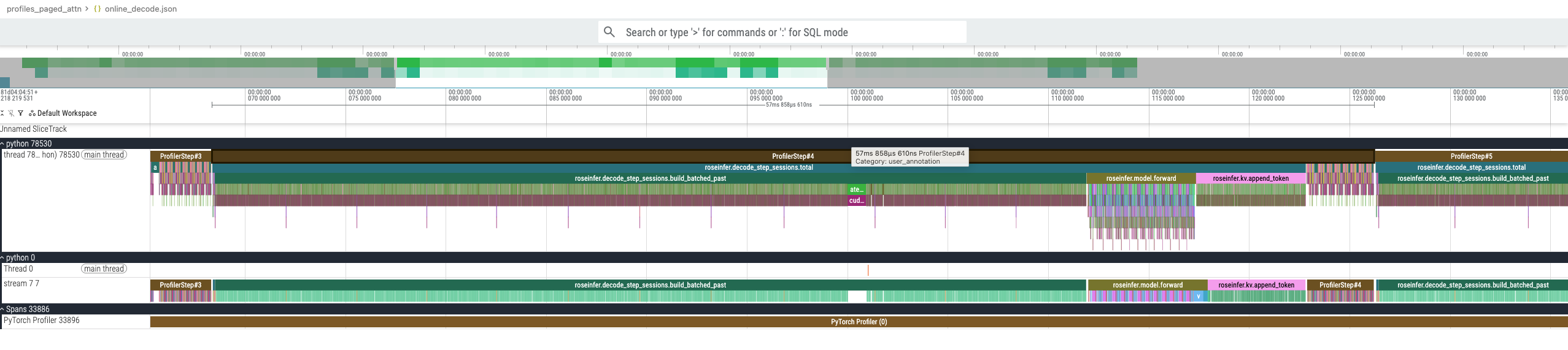
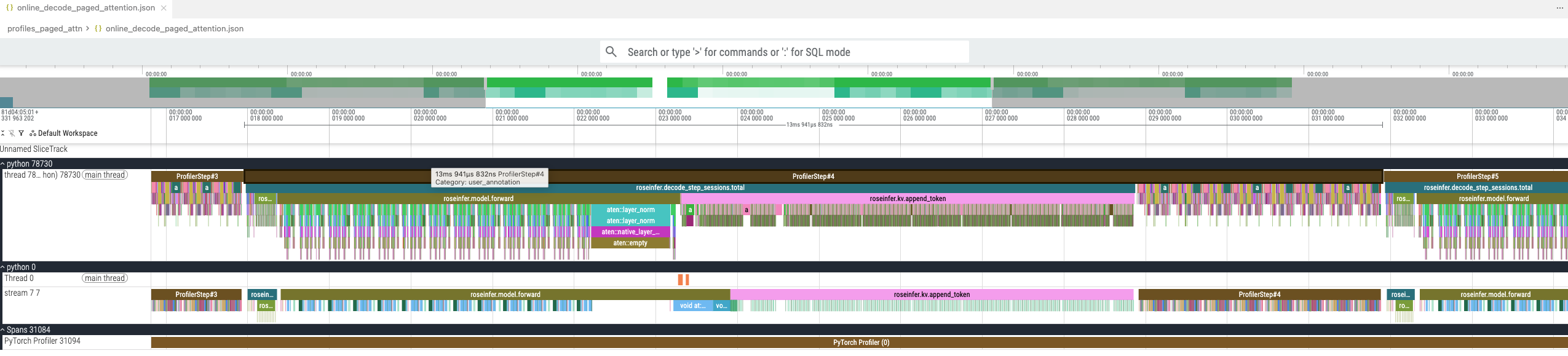
没用 paged attention 的时候一个 step 的开销是 57ms,用了之后是 13ms,并且 build_batched_past 的开销完全干掉了。