从零实现 LLM Inference:035. Paged Attention Fast Path
上一版我们把 prefill admission / decode loop 的调度策略逐步补齐了;但在算子层面,paged attention 这条路目前还没“跑顺”。
这次 mini PR 聚焦一个很具体的问题:paged attention decode(T=1) 的 fast path。
直觉上,paged attention 的 forward 已经完全不依赖 attention_mask(由 block_table + context_lens 决定有效 token 范围),所以 decode 每一步不应该再构建 dense 的 [B, L] mask。
但我们在 InferenceEngine.decode_step_sessions() 里,哪怕走 paged attention 分支,仍然会每步做:
torch.arange(max_len)->past_mask->cat->attention_mask
这段既有额外的 kernel/alloc,也会制造没必要的 GPU traffic。
另外一个小点:block_table 当前是每步从 Python list 构建出来,然后 per-layer 做 CPU->GPU copy;我们可以用一个 pinned CPU staging buffer 把 H2D copy 变成一次 non_blocking=True 的大拷贝。
代码变更
roseinfer/engine.py
- paged attention 分支不再构建
attention_mask(只保留position_ids+lens)。 - 增加
_get_paged_block_tables_cpu_buf():复用 pinned CPU buffer。 block_tables的 H2D copy 合并成一次,并标注一个新的 profiler range:roseinfer.decode_step_sessions.h2d_block_tables。
diff --git a/rosellm/roseinfer/engine.py b/rosellm/roseinfer/engine.py
index c41ed51..5c7f8b6 100644
--- a/rosellm/roseinfer/engine.py
+++ b/rosellm/roseinfer/engine.py
@@ -128,6 +128,8 @@ class InferenceEngine:
         )
         self._paged_block_tables_buf: torch.Tensor | None = None
         self._paged_block_tables_capacity: int = 0
+        self._paged_block_tables_cpu_buf: torch.Tensor | None = None
+        self._paged_block_tables_cpu_capacity: int = 0

@@ -869,6 +871,28 @@ class InferenceEngine:
             self._paged_block_tables_capacity = cap
         return self._paged_block_tables_buf

+    def _get_paged_block_tables_cpu_buf(
+        self,
+        batch_size: int,
+    ) -> torch.Tensor:
+        if (
+            self._paged_block_tables_cpu_buf is None
+            or self._paged_block_tables_cpu_capacity < batch_size
+        ):
+            cap = max(batch_size, self._paged_block_tables_cpu_capacity * 2, 16)
+            self._paged_block_tables_cpu_buf = torch.empty(
+                (
+                    self.config.n_layers,
+                    cap,
+                    self.max_blocks_per_seq,
+                ),
+                device="cpu",
+                dtype=torch.int32,
+                pin_memory=(self.device.type == "cuda"),
+            )
+            self._paged_block_tables_cpu_capacity = cap
+        return self._paged_block_tables_cpu_buf

@@ -893,7 +917,6 @@ class InferenceEngine:
                 seq_lens.append(seq_len)
             assert len(last_ids) == batch_size
             lens = torch.tensor(seq_lens, device=device, dtype=torch.long)
-            max_len = max(seq_lens)

@@ -901,22 +924,6 @@ class InferenceEngine:
                 device=device,
             ).view(batch_size, 1)
             position_ids = lens.view(batch_size, 1)
-            past_mask = torch.arange(
-                max_len,
-                device=device,
-            ).unsqueeze(0) < lens.unsqueeze(1)
-            new_mask = torch.ones(
-                batch_size,
-                1,
-                device=device,
-                dtype=past_mask.dtype,
-            )
-            attention_mask = torch.cat(
-                [past_mask, new_mask],
-                dim=1,
-            ).to(torch.long)
             num_layers = kvm.num_layers
@@
                 max_blocks_per_layer = kvm.max_blocks_per_layer
                 block_tables_buf = self._get_paged_block_tables_buf(batch_size)
+                block_tables_cpu = self._get_paged_block_tables_cpu_buf(batch_size)
                 with record_function(
                     "roseinfer.decode_step_sessions.build_block_tables",
                 ):
-                    block_tables: list[torch.Tensor] = []
                     for layer_idx in range(num_layers):
@@
-                        cpu_table = torch.tensor(rows, dtype=torch.int32)
-                        block_table = block_tables_buf[layer_idx, :batch_size]
-                        block_table.copy_(cpu_table)
-                        block_tables.append(block_table)
+                        tmp = torch.tensor(rows, dtype=torch.int32)
+                        block_tables_cpu[layer_idx, :batch_size].copy_(tmp)
+                with record_function(
+                    "roseinfer.decode_step_sessions.h2d_block_tables",
+                ):
+                    block_tables_buf[:, :batch_size].copy_(
+                        block_tables_cpu[:, :batch_size],
+                        non_blocking=True,
+                    )
+                block_tables = [
+                    block_tables_buf[layer_idx, :batch_size]
+                    for layer_idx in range(num_layers)
+                ]
@@
                 return last_logits

+            max_len = max(seq_lens)
+            past_mask = torch.arange(
+                max_len,
+                device=device,
+            ).unsqueeze(0) < lens.unsqueeze(1)
+            new_mask = torch.ones(
+                batch_size,
+                1,
+                device=device,
+                dtype=past_mask.dtype,
+            )
+            attention_mask = torch.cat(
+                [past_mask, new_mask],
+                dim=1,
+            ).to(torch.long)
运行
pytest -q
22 passed, 1 warning in 1.66s
Trace 图对比
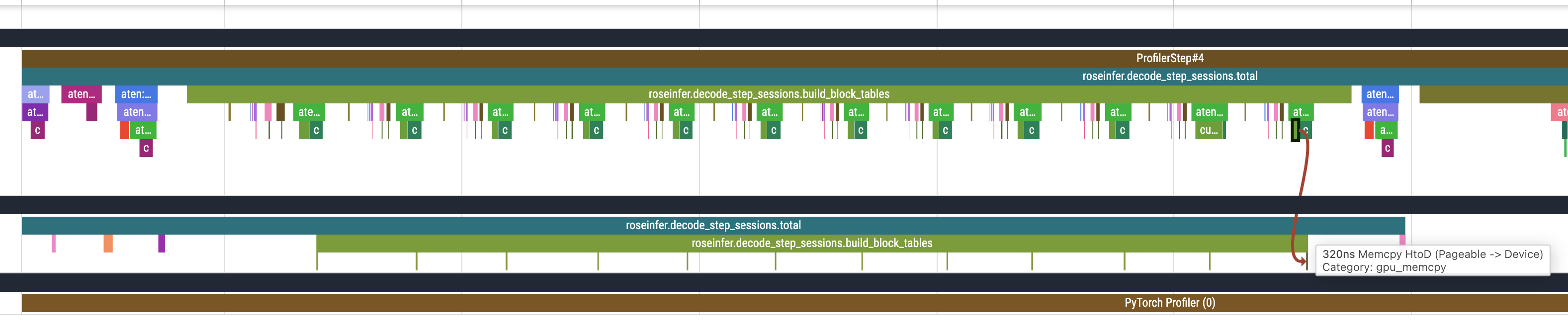
修改之前,我们可以发现在 build block tables 的时候会有很多次 HtoD 的 kernel launch,修改之后就只有一次 HtoD 的 kernel launch 了:

Benchmark(HF GPT-2)
为了让对比更稳定:
- 用
--pretok把 tokenizer 的耗时移出计时区间 - 用
--no-stop-on-eos固定每个请求 decode 的 token 数 - 用
--no-prefix-cache避免 prefix cache/COW 干扰
Before
python -m rosellm.roseinfer.benchmark_scheduler \
  --hf-model-id gpt2 --device cuda \
  --prompt "Hello" --num-requests 16 --max-new-tokens 256 \
  --mode online --max-batch-size 8 \
  --no-stop-on-eos --no-prefix-cache --pretok \
  --warmup-runs 1 --repeat-runs 3 \
  --paged-attn
=== online summary ===
Warmup runs: 1
Measured runs: 3
Decode time p50/mean: 2.145921/2.146833 s
Total time p50/mean: 2.188248/2.190020 s
Throughput(completion,decode) p50/mean: 1908.74/1907.93 tokens/s
Throughput(completion,total) p50/mean: 1871.82/1870.31 tokens/s
TTFT p50/mean: 2.68/2.67 ms
TPOT p50/mean: 8.45/8.46 ms/token
Latency p50/mean: 2157.70/2159.16 ms
After
python -m rosellm.roseinfer.benchmark_scheduler \
  --hf-model-id gpt2 --device cuda \
  --prompt "Hello" --num-requests 16 --max-new-tokens 256 \
  --mode online --max-batch-size 8 \
  --no-stop-on-eos --no-prefix-cache --pretok \
  --warmup-runs 1 --repeat-runs 3 \
  --paged-attn
=== online summary ===
Warmup runs: 1
Measured runs: 3
Decode time p50/mean: 2.132166/2.133335 s
Total time p50/mean: 2.174574/2.176261 s
Throughput(completion,decode) p50/mean: 1921.05/1920.00 tokens/s
Throughput(completion,total) p50/mean: 1883.59/1882.13 tokens/s
TTFT p50/mean: 2.65/2.66 ms
TPOT p50/mean: 8.40/8.40 ms/token
Latency p50/mean: 2143.61/2145.06 ms
这次提升不算大(GPT-2 context=1024,本身 block_table 很小),但方向是对的:paged attention 的 decode path 先把“无意义的 dense mask 构建”和“碎片化的 H2D copy”清掉,后面再继续往 block_table 常驻 GPU / 增量更新 / 更大 context 的模型推进。