从零实现 LLM Inference:040. CUDA Graph 加速 paged decode
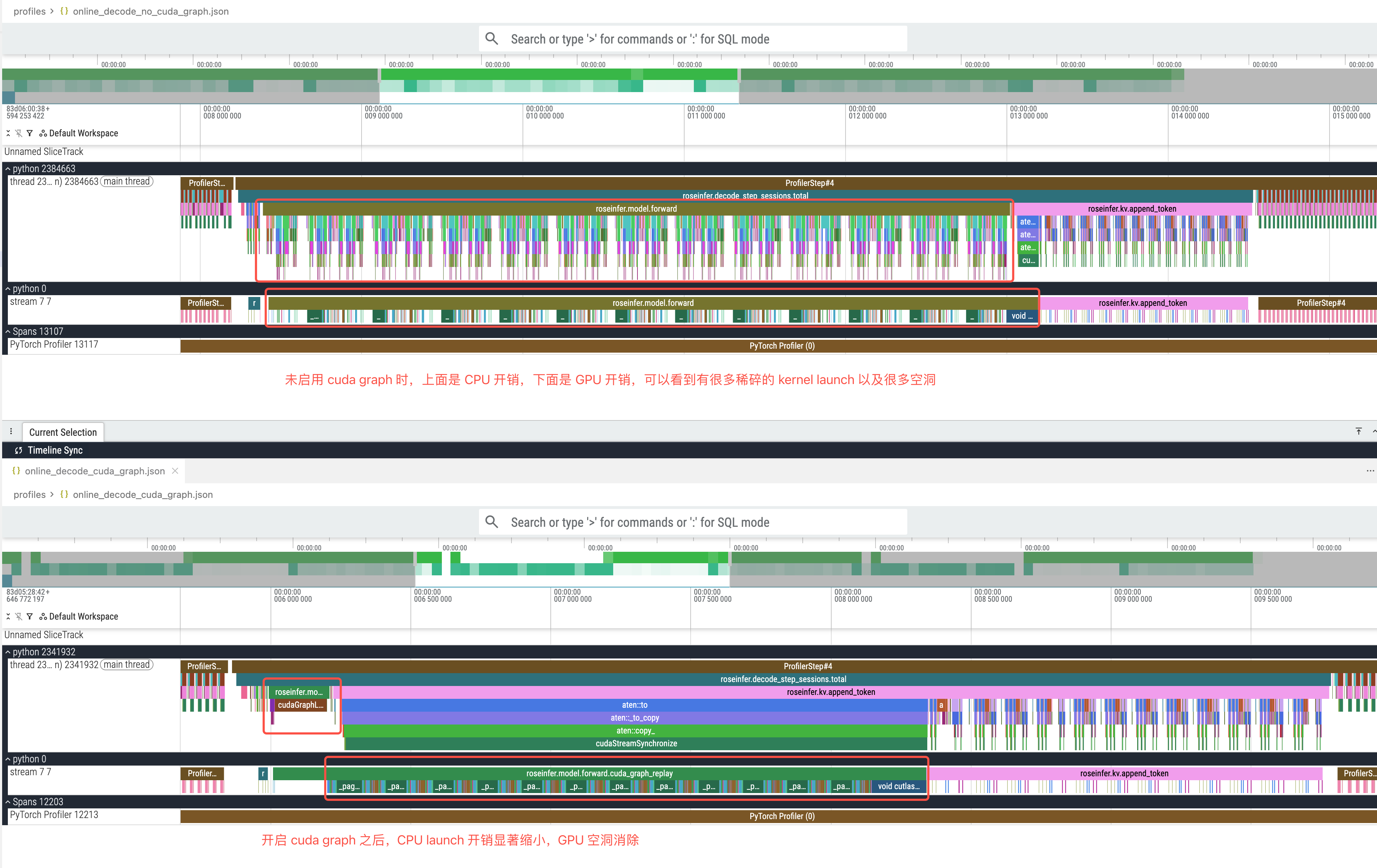
paged attention 跑起来以后,GPU 这边已经很“实”了,但 decode 依然有一个很典型的瓶颈:kernel launch 太密。
以 GPT-2 为例:
L=12层- decode
T=512步
这意味着 一次 run 至少有 12*512=6144 次 attention kernel launch,再算上 qkv/ffn/ln 等等,launch 数量更夸张。很多时候 GPU 并不是算不动,而是 CPU 在不停地 dispatch。
CUDA Graph 的核心价值就是:把这段固定形状的 CUDA work 录下来,后面直接 replay,把大量 CPU-side dispatch 开销砍掉。
这版只做一件事:给 paged decode(T=1) 加一个可选的 CUDA Graph fast-path。
不使用 cuda graph 和使用 cuda graph 的 profile 对比:
代码变更
roseinfer/engine.py
做法很直接:
InferenceEngine增加use_cuda_graph开关- 维护一个
batch_size -> graph的 cache(batch size 固定时收益最好) - graph 里 capture 的是 一次完整的 model forward(paged decode, use_cache=True)
- 每个 step 只做:
- 把新的
input_ids/position_ids/slot_mapping/context_lens拷进静态 buffer graph.replay()
- 把新的
核心 diff:
diff --git a/rosellm/roseinfer/engine.py b/rosellm/roseinfer/engine.py
@@
+@dataclass
+class _PagedDecodeCudaGraph:
+    batch_size: int
+    global_block_tables_ptr: int
+    graph: torch.cuda.CUDAGraph
+    input_ids: torch.Tensor
+    position_ids: torch.Tensor
+    slot_mapping: torch.Tensor
+    context_lens: torch.Tensor
+    logits: torch.Tensor
+    presents: list[tuple[torch.Tensor, torch.Tensor]]
@@
 class InferenceEngine:
     def __init__(
@@
-        use_paged_attention: bool = False,
+        use_paged_attention: bool = False,
+        use_cuda_graph: bool = False,
@@
+        self.use_cuda_graph = (
+            bool(use_cuda_graph)
+            and self.device.type == "cuda"
+            and torch.cuda.is_available()
+        )
+        self._paged_decode_cuda_graphs: dict[int, _PagedDecodeCudaGraph] = {}
+        self._cuda_graph_pool = (
+            torch.cuda.graphs.graph_pool_handle() if self.use_cuda_graph else None
+        )
@@
+    def _get_or_create_paged_decode_cuda_graph(
+        self,
+        *,
+        batch_size: int,
+        global_block_tables: torch.Tensor,
+    ) -> _PagedDecodeCudaGraph:
+        ...
+        # warmup -> torch.cuda.graph(...) capture -> cache by batch_size
+        ...
@@ def decode_step_sessions(self, sessions):
-                paged = PagedKVCache(...)
-                logits, _, presents = self.model(..., paged_kv_cache=paged)
+                if self.use_cuda_graph:
+                    graph = self._get_or_create_paged_decode_cuda_graph(...)
+                    graph.input_ids[:, 0].copy_(torch.tensor(last_ids, dtype=torch.long), non_blocking=True)
+                    graph.position_ids[:, 0].copy_(torch.tensor(seq_lens, dtype=torch.long), non_blocking=True)
+                    graph.slot_mapping.copy_(torch.tensor(slot_ids, dtype=torch.int32), non_blocking=True)
+                    graph.context_lens.copy_(torch.tensor(seq_lens, dtype=torch.int32), non_blocking=True)
+                    graph.graph.replay()
+                    logits = graph.logits
+                    presents = graph.presents
+                else:
+                    paged = PagedKVCache(...)
+                    logits, _, presents = self.model(..., paged_kv_cache=paged)
注意点:
- 必须 warmup 再 capture:否则 Triton 首次编译/allocator 扩容会直接让 capture 失败
- graph 只对 固定 batch size + decode(T=1) 这种热路径最友好;batch size 变了就走 fallback
roseinfer/benchmark_scheduler.py
加一个开关 --cuda-graph:
diff --git a/rosellm/roseinfer/benchmark_scheduler.py b/rosellm/roseinfer/benchmark_scheduler.py
@@
     parser.add_argument(
         "--paged-attn",
         action="store_true",
         help="Use paged attention",
     )
+    parser.add_argument(
+        "--cuda-graph",
+        action="store_true",
+        help="Use CUDA Graph for decode(T=1) when possible (CUDA only).",
+    )
@@
         engine = InferenceEngine(
@@
             use_paged_attention=args.paged_attn,
+            use_cuda_graph=args.cuda_graph,
         )
运行
pytest -q
......................                                                   [100%]
=============================== warnings summary ===============================
../anaconda3/lib/python3.10/site-packages/urllib3/util/ssl_.py:260
  /data/projects/anaconda3/lib/python3.10/site-packages/urllib3/util/ssl_.py:260: DeprecationWarning: ssl.PROTOCOL_TLS is deprecated
    context = SSLContext(ssl_version or PROTOCOL_TLS)

-- Docs: https://docs.pytest.org/en/stable/how-to/capture-warnings.html
22 passed, 1 warning in 1.61s
Benchmark(HF GPT-2)
命令(固定 workload,收敛到 decode 热路径):
python -m rosellm.roseinfer.benchmark_scheduler \
  --hf-model-id gpt2 --device cuda \
  --prompt "Hello" --num-requests 64 --max-new-tokens 512 \
  --mode online --max-batch-size 64 \
  --no-stop-on-eos --no-prefix-cache --pretok \
  --warmup-runs 1 --repeat-runs 3 \
  --paged-attn
Before(不开 CUDA Graph)
=== online summary ===
Warmup runs: 1
Measured runs: 3
Decode time p50/mean: 3.391189/3.392113 s
Total time p50/mean: 3.570067/3.568646 s
Throughput(completion,decode) p50/mean: 9662.69/9660.06 tokens/s
Throughput(completion,total) p50/mean: 9178.54/9182.20 tokens/s
TTFT p50/mean: 2.78/2.75 ms
TPOT p50/mean: 6.67/6.68 ms/token
Latency p50/mean: 3412.77/3413.99 ms
After(开 CUDA Graph)
python -m rosellm.roseinfer.benchmark_scheduler \
  --hf-model-id gpt2 --device cuda \
  --prompt "Hello" --num-requests 64 --max-new-tokens 512 \
  --mode online --max-batch-size 64 \
  --no-stop-on-eos --no-prefix-cache --pretok \
  --warmup-runs 1 --repeat-runs 3 \
  --paged-attn --cuda-graph
=== online summary ===
Warmup runs: 1
Measured runs: 3
Decode time p50/mean: 3.102104/3.101720 s
Total time p50/mean: 3.276822/3.277024 s
Throughput(completion,decode) p50/mean: 10563.15/10564.46 tokens/s
Throughput(completion,total) p50/mean: 9999.93/9999.32 tokens/s
TTFT p50/mean: 2.72/2.72 ms
TPOT p50/mean: 6.11/6.11 ms/token
Latency p50/mean: 3125.11/3124.65 ms
结论
CUDA Graph 这类优化非常“朴素”:不改算子、不改模型结构,只是把 decode 热路径的 CPU dispatch 切成 replay。
在这组 GPT-2 的数据上:
- decode 吞吐(mean):
9660.06 → 10564.46 tokens/s(约 +9.36%) - TPOT(mean):
6.68 → 6.11 ms/token(约 -8.53%)
后面如果要继续往前推:
- 让更多 batch size 命中 graph cache(或者做 padding/分桶)
- 把 graph replay 的范围扩到更多 decode 侧的固定开销(比如一些固定形状的 tensor 构造/拷贝)