Each LCP cell comes from neighboring rows after sorting, not from arbitrary substrings.
LCP Array Only
LCP Array Primer
This page teaches LCP itself: how long adjacent sorted suffixes match from the start, and why Kasai computes those lengths in linear time.
This page answers one question: how adjacent sorted suffixes expose stable common-prefix lengths. After reading, you should be able to connect lcp[p], rank[i], h carry, and the Kasai scan.
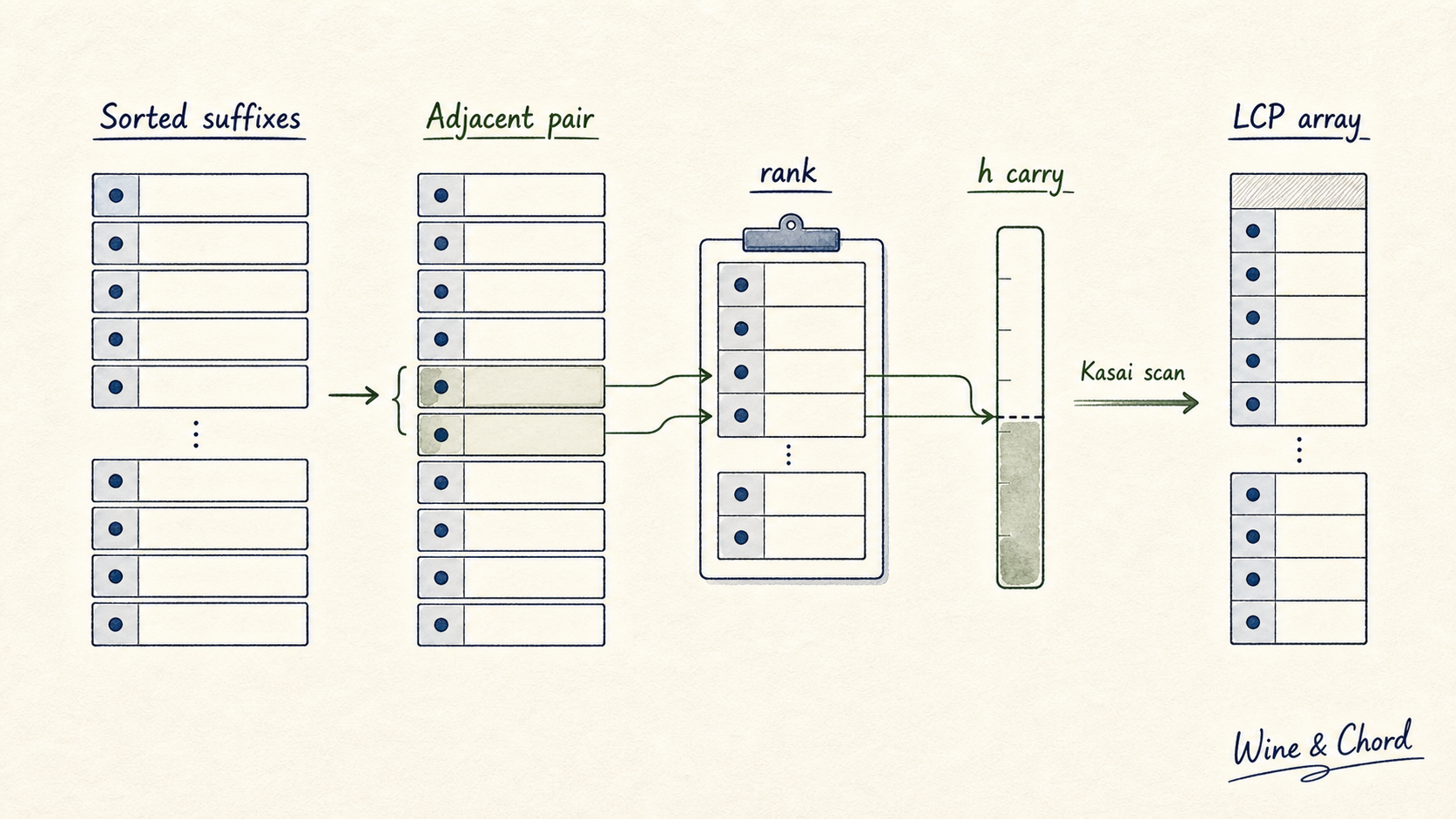
Kasai becomes linear because the next start can inherit h-1 before extending.
You should know lcp[p] compares sa[p] with sa[p-1], and the value is a length.
Why
Adjacent suffixes
Aligned comparison
Kasai scan
| i | rank | start | h | LCP |
|---|
Knowledge links
What suffix arrays are LCP assumes suffixes are already sorted; suffix arrays do that sorting. Application: shortest unique subarray The application uses suffix-array neighbors and LCP lengths together.C++
Core code
The key in Kasai is not the while loop alone; it is reusing h so the next start inherits h-1 before extending.
vector<int> buildLCP(string s, vector<int>& sa) { int n = s.size(); vector<int> rank(n), lcp(n, 0); for (int i = 0; i < n; i++) rank[sa[i]] = i; int h = 0; for (int i = 0; i < n; i++) { int p = rank[i]; if (p == 0) continue; int j = sa[p - 1]; while (i + h < n && j + h < n && s[i + h] == s[j + h]) h++; lcp[p] = h; if (h > 0) h--; } return lcp;}