Every table is about moving start indices; suffix text only helps verify the order.
Suffix Array Only
Suffix Array Primer
This page teaches the suffix array itself: suffixes, lexicographic order, rank classes, and why doubling can compare longer prefixes from two known halves.
This page answers one question: why a suffix array can represent lexicographic order with sorted start indices. After reading, you should be able to connect suffixes, rank, pair keys, and doubling.
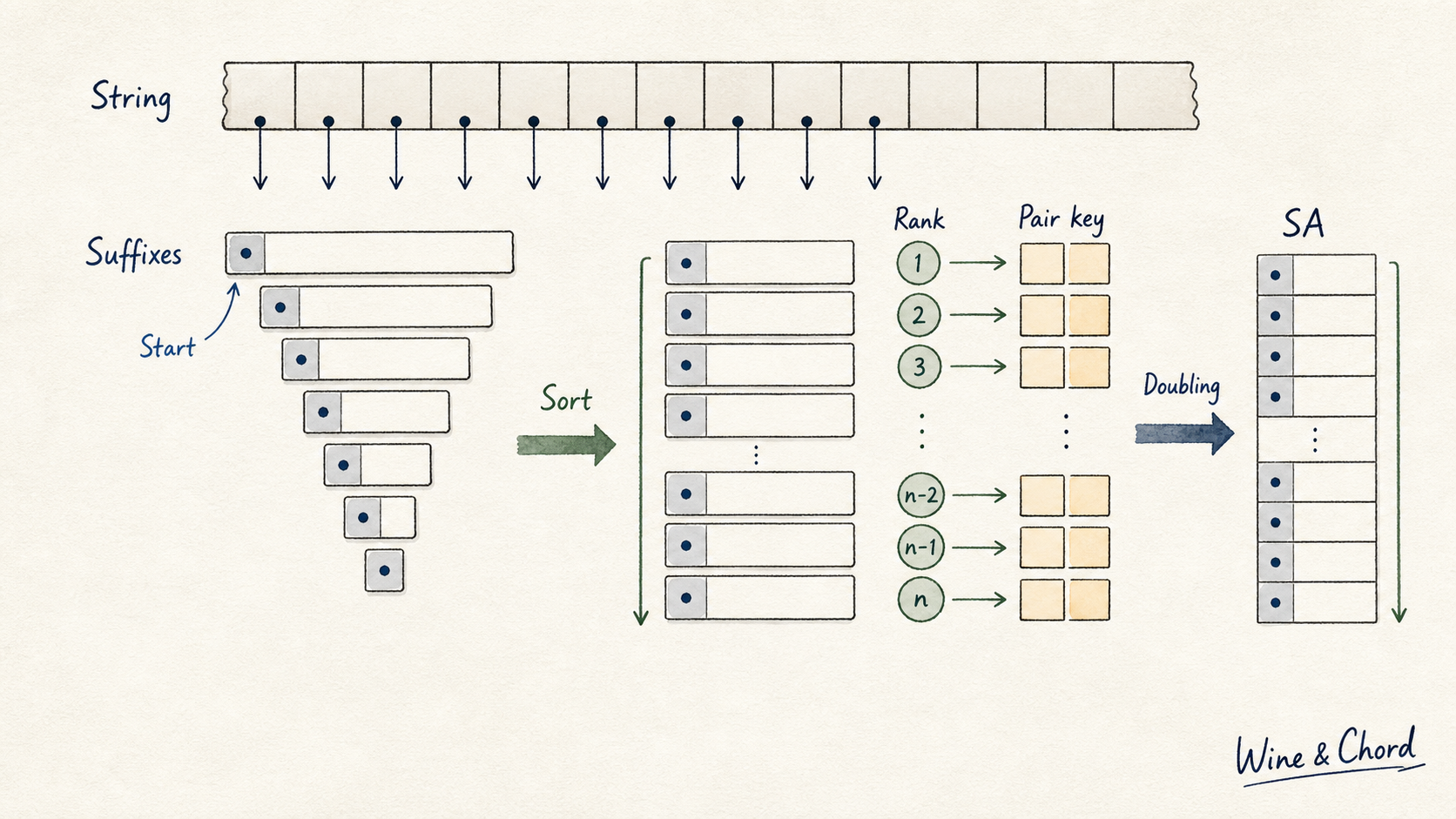
Doubling reuses old ranks as pairs instead of comparing whole strings again.
You should leave knowing that sa stores sorted start positions, not copied suffix strings.
Why
Original string
Suffix lab
Current round
| # | start | suffix | key | new rank |
|---|
Knowledge links
What LCP means The suffix array only sorts suffixes. LCP explains how far adjacent suffixes match. Application: shortest unique subarray The problem combines suffix arrays with LCP, but the base ideas stay separate.C++
Core code
This code shows the doubling skeleton. The point is not memorizing a template, but seeing how ranks name comparable prefixes.
vector<int> buildSuffixArray(string s) { s += '$'; int n = s.size(); vector<int> sa(n), cls(n); vector<pair<char, int>> first(n); for (int i = 0; i < n; i++) first[i] = {s[i], i}; sort(first.begin(), first.end()); for (int i = 0; i < n; i++) sa[i] = first[i].second; cls[sa[0]] = 0; for (int i = 1; i < n; i++) { cls[sa[i]] = cls[sa[i - 1]]; if (first[i].first != first[i - 1].first) cls[sa[i]]++; } for (int len = 1; len < n; len <<= 1) { sort(sa.begin(), sa.end(), [&](int a, int b) { if (cls[a] != cls[b]) return cls[a] < cls[b]; return cls[(a + len) % n] < cls[(b + len) % n]; }); vector<int> next(n); next[sa[0]] = 0; for (int i = 1; i < n; i++) { pair<int, int> prev = { cls[sa[i - 1]], cls[(sa[i - 1] + len) % n], }; pair<int, int> now = { cls[sa[i]], cls[(sa[i] + len) % n], }; next[sa[i]] = next[sa[i - 1]] + (prev != now); } cls = next; } sa.erase(sa.begin()); return sa;}