Decoder Block
现代 decoder-only 模型反复堆叠两类变换:attention 在 token 之间交换信息,MLP 在每个 token 的通道内变换表示。残差与归一化决定这些变换能否在很深的网络中稳定组合。
基本计算图
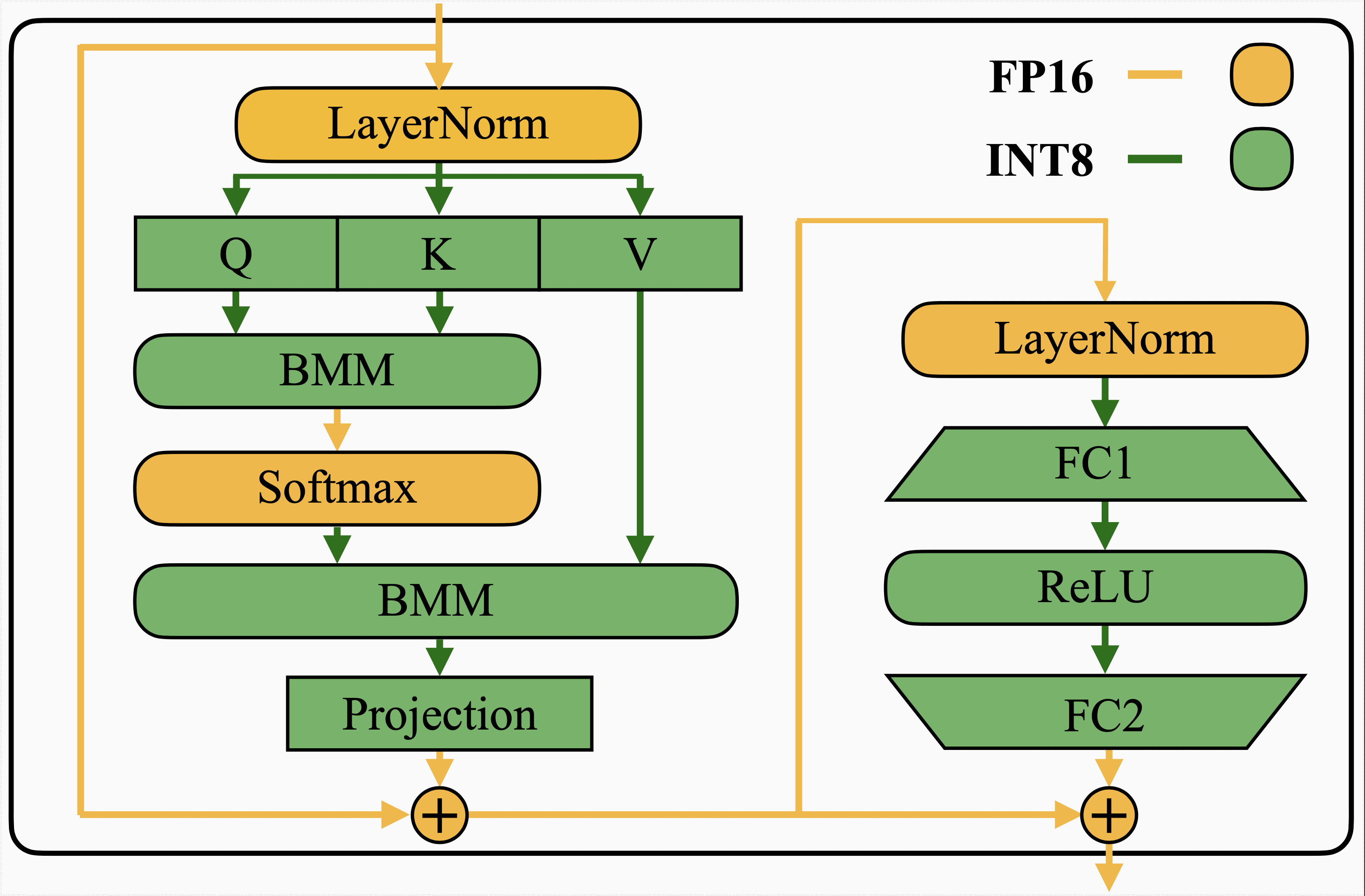
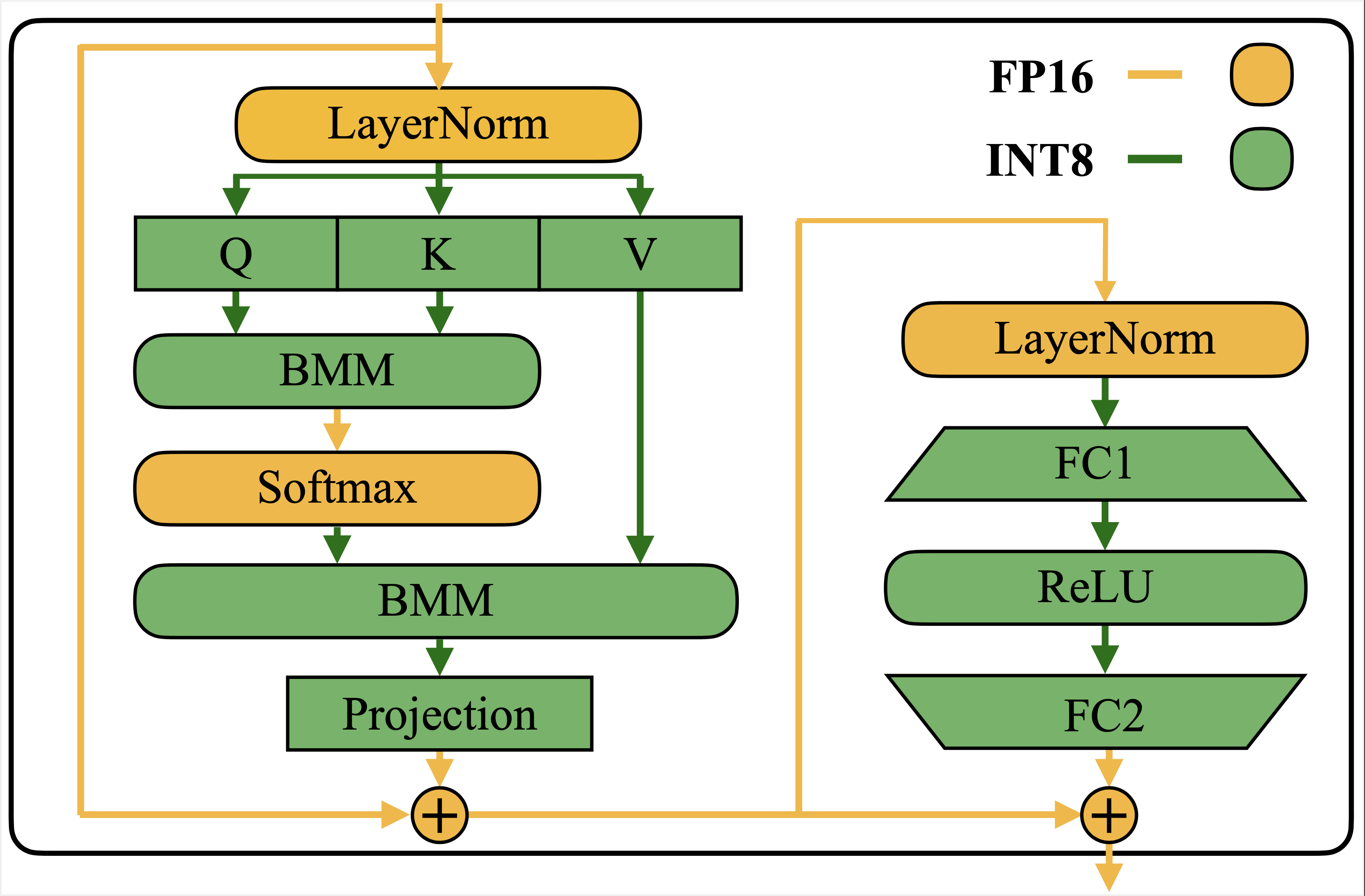
pre-norm block 可写成
post-norm 则先做残差相加,再归一化:
pre-norm 给恒等残差路径提供更直接的梯度通道,通常更容易训练深层网络;post-norm 的表示尺度与优化行为不同,不能只替换一行代码而沿用全部超参数。
LayerNorm 与 RMSNorm
对 \(x\in\mathbb{R}^{d}\),LayerNorm 为
其中
RMSNorm 不做中心化:
RMSNorm 计算更简单,但“没有减均值”不等于可以忽略数值路径。归约精度、\(\epsilon\)、权重 dtype、残差累加与 fused kernel 都可能影响 checkpoint 一致性。
MLP 与 gated activation
普通两层 MLP 为
gated MLP 增加一条门控分支。SwiGLU 常写为
若为了保持参数量接近而调整中间宽度,必须说明比较的是相同 hidden width、相同参数量还是相同 FLOPs。激活函数名称不能代替矩阵形状。
SiTU-GLU:给乘法分支加平滑上界
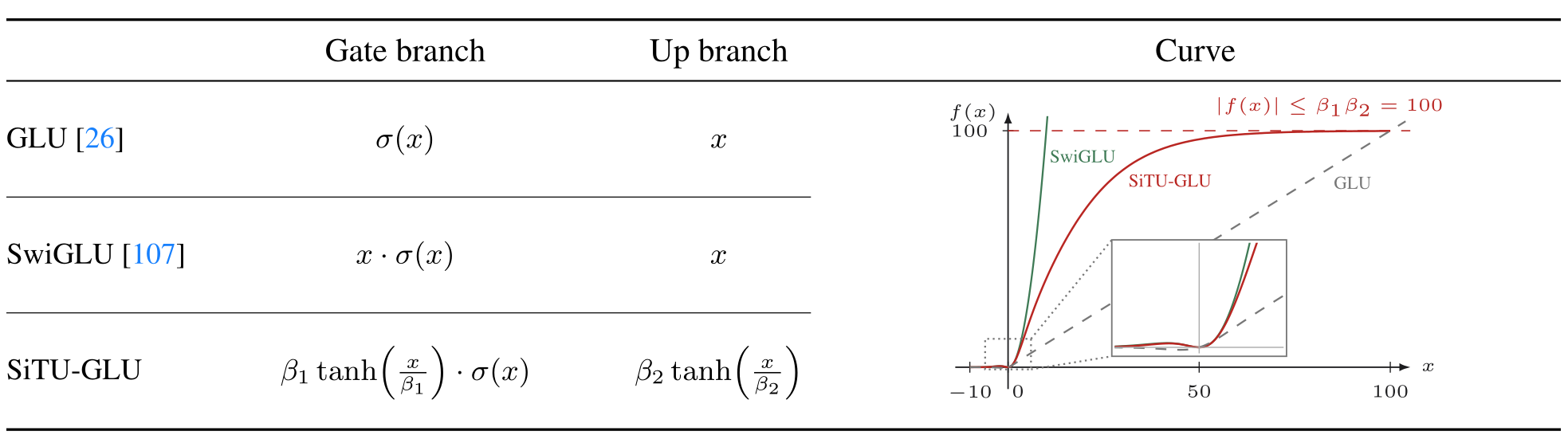
SwiGLU 的 gate factor \(a\operatorname{Sigmoid}(a)\) 与 up factor \(b\) 都无界;二者在同一坐标同时变大时, 乘积会近似二次增长。大规模、低精度训练中,这类 outlier 会沿 expert MLP 和 residual path 放大。 直接 hard clamp 能截断数值,却在阈值外给出零梯度和不连续的导数变化。
定义 smooth cap
Kimi K3 技术报告提出 Sigmoid Tanh Unit GLU(SiTU-GLU),分别约束 gate 的线性因子与 up branch:
当 \(z\to0\) 时,\(\beta\tanh(z/\beta)=z+O(z^3/\beta^2)\),因此局部保留 SwiGLU 的一阶形状; 当 \(\beta_1,\beta_2\to\infty\) 时逐点回到 SwiGLU。另一方面, \(|\tanh z|<1\) 且 \(0<\operatorname{Sigmoid}z<1\),所以 down-projection 之前的每个坐标满足
K3 取 \(\beta_1=4,\beta_2=25\),上界为 \(100\)。这个上界约束的是 elementwise gated hidden, 不是经过 \(W_d\) 后的 MLP 输出,也不等于全模型不会出现 outlier。K3 将它用于 Stable LatentMoE 的 routed experts;完整架构关系见 Kimi K3。
SiTU-GLU reference
import torch
import torch.nn.functional as F

def softcap(x, beta):
    assert beta > 0
    return beta * torch.tanh(x / beta)

def situ_glu(gate_logit, up_value, beta1=4., beta2=25.):
    assert gate_logit.shape == up_value.shape
    gate = softcap(gate_logit, beta1) * torch.sigmoid(gate_logit)
    return gate * softcap(up_value, beta2)

extreme = torch.tensor([-1e4, -10., 0., 10., 1e4])
hidden = situ_glu(extreme, extreme)
assert hidden.abs().max() <= 100
small = torch.linspace(-1e-3, 1e-3, 17, dtype=torch.float64)
torch.testing.assert_close(
    situ_glu(small, small), F.silu(small) * small, atol=1e-12, rtol=1e-6,
)
实现 checkpoint 时还要固定 gate/up 投影是否带 bias、\(\beta\) 是常数还是可学习参数、激活计算 dtype 以及 fused kernel 的近似误差。只替换 activation 而沿用另一配方的初始化、宽度和学习率,不能隔离 SiTU-GLU 自身的效果。
最小语义实现
下面把 pre-norm block 的三项核心语义放在同一计算图里:RMSNorm 用 FP32 归约后转回输入 dtype,SwiGLU 保留 gate/up 两条投影,两个子层都写回同一 residual stream。输入和输出均为 [batch, time, dim];attn 是保持该 shape 的可替换模块。
import torch
import torch.nn as nn
import torch.nn.functional as F

class RMSNorm(nn.Module):
    def __init__(self, dim, eps=1e-6):
        super().__init__()
        self.weight = nn.Parameter(torch.ones(dim))
        self.eps = eps
    def forward(self, x):
        scale = x.float().square().mean(-1, keepdim=True).add(self.eps).rsqrt()
        return (x.float() * scale * self.weight.float()).to(x.dtype)

class SwiGLU(nn.Module):
    def __init__(self, dim, hidden):
        super().__init__()
        self.gate, self.up = nn.Linear(dim, hidden), nn.Linear(dim, hidden)
        self.down = nn.Linear(hidden, dim)
    def forward(self, x):
        return self.down(F.silu(self.gate(x)) * self.up(x))

class DecoderBlock(nn.Module):
    def __init__(self, dim, hidden, attn):
        super().__init__()
        self.n1, self.attn, self.n2 = RMSNorm(dim), attn, RMSNorm(dim)
        self.mlp = SwiGLU(dim, hidden)
    def forward(self, x, **attn_kwargs):
        x = x + self.attn(self.n1(x), **attn_kwargs)
        return x + self.mlp(self.n2(x))

x = torch.randn(2, 5, 16)
y = DecoderBlock(16, 32, nn.Identity())(x)
assert y.shape == x.shape and torch.isfinite(y).all()
x16 = torch.randn(2, 5, 16, dtype=torch.float16)
assert RMSNorm(16)(x16).dtype == x16.dtype
这是结构参考而非 checkpoint 兼容层:attention 的 head/position/cache 契约、bias、初始化、dropout、tensor parallel 与 fused residual-norm 都必须由具体模型补齐。逐算子版本见张量原语:LayerNorm 与 RMSNorm,带 causal attention 和增量缓存的组合见 Decoder-only Transformer:RMSNorm、SwiGLU 与 Block。
残差尺度
每层都把新分支写回 residual stream。深度增加后,初始化、norm 位置、分支 scale 与残差 dtype 共同决定方差传播。常见控制包括:
- 按深度缩放部分输出投影初始化;
- 为残差分支增加固定或可学习系数;
- 保留更高精度的 residual accumulation;
- 对不同参数类型采用不同学习率或更新尺度;
- 增加跨层连接或多流残差,但必须重新定义状态和缓存。
这些技巧不是可随意叠加的“稳定性插件”。更换残差拓扑会改变函数类、优化条件和并行实现,应在等计算预算下做消融。
Hyper-Connections 与 mHC:把 residual width 变成独立维度
普通 residual stream 只有一条状态。Hyper-Connections 将其扩成
其中 \(A_l\)从多条 residual 中读出一个 \(d\)-维 layer input,\(C_l\)把 layer output 写回多条流,\(B_l\)负责跨层搬运原状态。它在不改变内部 attention / MLP hidden width 的情况下增加了 depth mixing 自由度,但任意 \(B_l\) 连乘可能放大或抵消信号。
mHC 把 \(B_l\)投影到 Birkhoff polytope:
双随机矩阵的谱范数不超过 1,且集合对乘法封闭;\(A_l=\sigma(\widetilde A_l)\)、\(C_l=2\sigma(\widetilde C_l)\)也保持非负有界。DeepSeek-V4 取 \(n_{\mathrm{hc}}=4\),用 20 次 Sinkhorn row/column normalization 得到 \(B_l\),并通过融合、选择性重算与修改的 pipeline 把报告中的 wall-time 增量控制在 6.7%。这是特定系统测量,不等于所有实现只增加 6.7%。
mHC 与 K3 的 Attention Residuals 都改变 layer 之间的信息流,但前者只混合固定宽度的当前 residual state,后者对更早 layer/block 表示做内容寻址,状态与系统接口不同。
V4 的分段 SwiGLU clamp
V4 没有使用 SiTU-GLU,而是对 SwiGLU 的两条 pre-activation 分别做分段线性裁剪:linear branch 限制到 \([-10,10]\),gate branch 只设置上界 10。它在正常区间保持原函数,越界后产生 hard saturation;与平滑 tanh cap 的梯度性质不同。报告只给出这项经验稳定措施,没有给出为何与 anticipatory routing 共同阻止 loss spike 的完整理论。
Dropout 与训练—推理差异
attention probability、MLP、residual 或 embedding 都可能使用 dropout。现代大规模预训练有时将其设为零,但这取决于数据规模和配方。推理必须关闭 dropout;activation checkpointing 的重算则必须恢复相同随机状态,否则反向对应的是另一条计算图。
实现契约
一个 block 的 checkpoint 兼容性至少取决于:
norm type, epsilon and placement
Q/K/V/O projection shapes and biases
head layout and positional transform
MLP activation, gate order and intermediate size
residual scaling and accumulation dtype
dropout locations
parameter names, tying and tensor layout
两个实现输出 shape 相同,不代表权重可直接互换。
调试顺序
- 用 FP32 小张量核对 norm、MLP 和残差的独立输出。
- 固定权重,逐子层比较 hidden state。
- 检查训练与增量推理的 position、mask 和 cache。
- 再启用 fused norm、fused MLP、低精度和 tensor parallel。
- 记录第一个发生数值分叉的层,而不是只比较最终 logits。
attention 细节见注意力家族,完整主干见 Transformer,优化稳定性见优化与稳定性。