Kimi K2.5:原生多模态、联合 RL 与 Agent Swarm
Kimi K2.5 在 Kimi 家族中把两条此前相对独立的路线接到一起:一条从 Kimi-VL 出发,研究视觉 token 怎样与语言共同预训练和强化学习;另一条 从 Kimi K2 出发,研究长程 agent 怎样在工具世界中行动。连接点不是“给 agent 多看一张 图”,而是让 text、vision、reasoning、tool use 与 parallel orchestration 共享训练主干和 outcome。
报告最值得保留的历史位置也在这里:Kimi k1.5 把搜索压进一条长 CoT,K2 把这条轨迹接入真实工具, K2.5 则让一个可训练 orchestrator 动态创建多个 frozen subagent。test-time compute 从“时间轴上继续 生成”扩展到“空间轴上并行探索”。
先分开模型、训练阶段与系统模式
官方技术报告 公开的主体是建立在 K2 Base 上的 native multimodal model:
| 层面 | K2.5 的公开对象 |
|---|---|
| language backbone | K2 MoE:1.04T total / 32.6B activated,384 experts、top-8 |
| vision path | MoonViT-3D + MLP projector |
| context | 最长 256K;长上下文阶段从 32K 扩到 256K |
| interaction modes | instant / thinking、text / vision、chat / agent |
| swarm | trainable orchestrator + dynamically instantiated frozen subagents |
| weights | post-trained checkpoint 与官方 inference artifacts |
这里有两个常见错位。第一,Agent Swarm 是 post-training 与 inference system,不是 MoonViT-3D 的 结构组件;单模型 K2.5 与 swarm mode 的成本和评测也不同。第二,K2.5 以 K2 checkpoint 为 language foundation,不应把 K2 的 15.5T text pretraining 与 K2.5 的后续 multimodal token 混成同一次从零训练。
官方 artifact 使用 Modified MIT License: 超过 1 亿月活或月收入 2,000 万美元的商业产品 / 服务需要在界面显著展示“Kimi K2.5”。这项附加条件 意味着它不应被简称为未修改的标准 MIT。
早融合的真正对照:固定总预算,改变何时看见视觉
多模态 continual pretraining 常见做法是先把语言模型训到后期,再以很高视觉比例快速“接入”图片。 K2.5 的受控实验固定 visual / text token 总预算,只改变视觉注入时点与比例:
| 注入策略 | vision injection timing | vision:text | 报告中的现象 |
|---|---|---|---|
| early | 0% | 10:90 | 六项 visual / text aggregate 中整体最好 |
| mid | 50% | 20:80 | 语言 reasoning 接近,但视觉指标下降 |
| late | 80% | 50:50 | visual 与 text 指标都更弱 |
更准确的结论不是“视觉比例越低越好”,而是:在这组固定 token 预算的配方内,较早、较温和的长期 共适应优于末期高比例注入。late injection 会让文本能力评测分数出现先下降再恢复的 dip-and-recover; early fusion 给共享 backbone 更长时间调整 cross-modal representation。
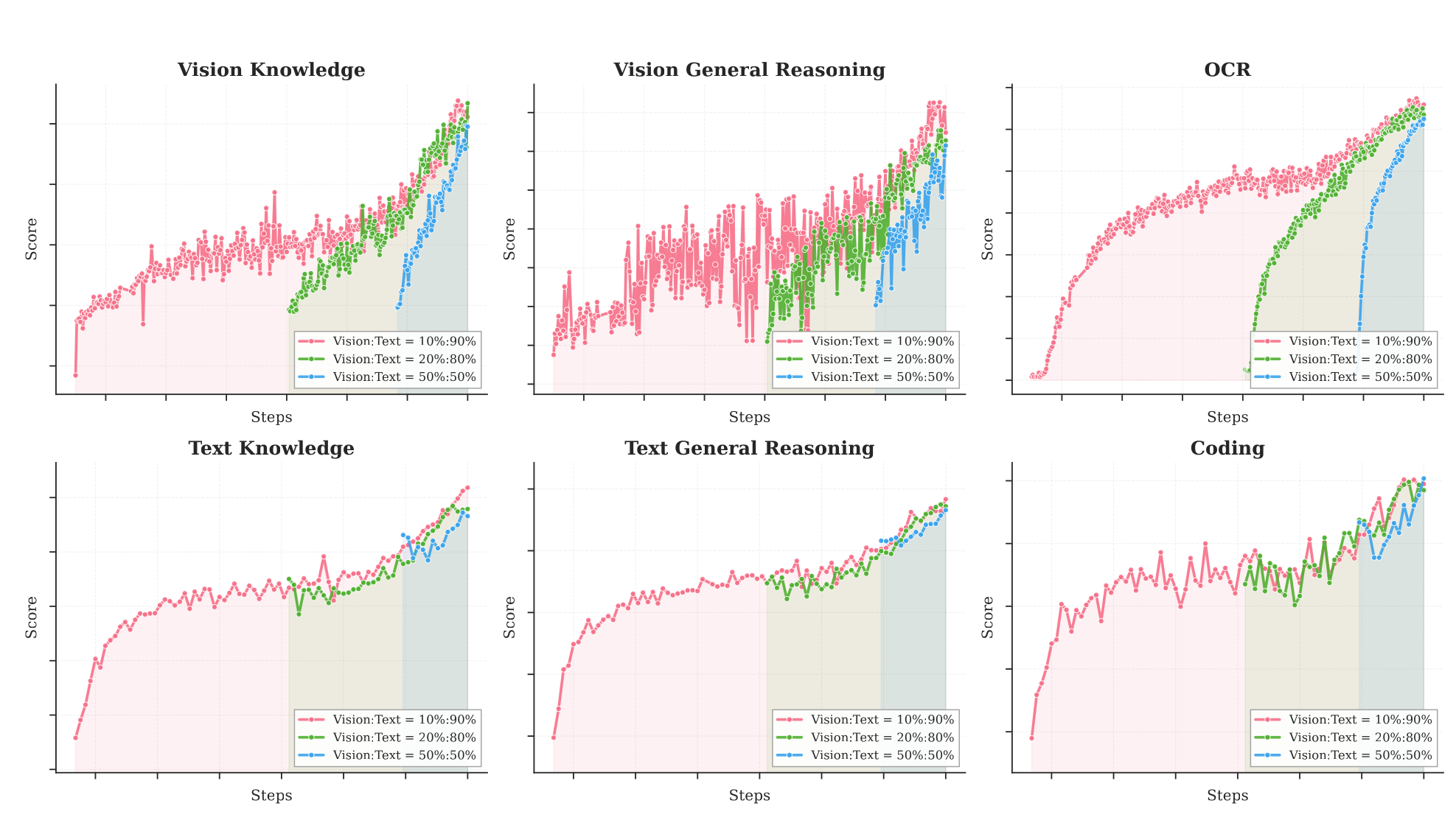
这项消融没有公开所有模型规模、seed、per-source mixture 与训练方差,因而不足以推出跨架构最优比例。 它提供的是一个实验设计原则:比较融合策略时必须固定总 visual tokens、总 text tokens 与总 compute, 不能把“更早注入”和“额外看了更多图”混在一起。
MoonViT-3D:用同一空间理解图像与视频
K2.5 的视觉路径沿用 Kimi-VL 的 native-resolution 思想。图像按原始宽高 patchify,不做固定方形 resize 或多 crop 拼接;不同尺寸的 patch sequence 通过 NaViT-style packing 合并成 variable-length batch。
MoonViT-3D 将这个“patch n' pack”扩到时间轴:
- 最多四个连续 frame 组成一个 spatiotemporal volume;
- 每帧的 2D patches 一起 flatten / pack,由同一套 attention 参数处理;
- 在 projector 前按相同空间位置做轻量 temporal pooling;
- 四帧压成一组视觉表示,在相同 context budget 下可覆盖约 \(4\times\) 更长视频。
图像与视频 encoder 完全共享参数和 embedding space,减少架构分叉,也让静态图像知识直接迁移到视频。 代价是 temporal pooling 会丢失组内的细粒度顺序;高速动作、瞬时事件与精确 timestamp 仍需用更密的 sampling 或专门评测检验。
它也不等于 Kimi K3 的 MoonViT-V2。K2.5 报告描述 MoonViT-3D 的 shared image-video path;K3 则从 next-token objective 重新训练视觉塔并接入另一套 hybrid backbone。
约 15T 的后续训练应该怎样计数
报告表 3 将 K2.5 分为:
| stage | 主要数据 | sequence | token 口径 | trainable |
|---|---|---|---|---|
| ViT training | alt text、caption、grounding、OCR、video | 4K | 1T | ViT |
| joint pretraining | text、knowledge、interleaving、video、OS screenshot | 4K | 15T | ViT + LLM |
| long-context mid-training | 高质量 text / multimodal、long video、reasoning / long-CoT | 32K→256K | 500B→200B | ViT + LLM |
正文同时把完整后续流程概括为“approximately 15T tokens across three stages”,又明确说 joint pretraining 本身有 additional 15T vision-text tokens。最稳妥的读法是把“约 15T”视为 rounded headline,把各 stage 表格保留为自己的披露口径;不能把 1T、15T、500B、200B 机械相加后宣称得到 官方精确总量。
ViT stage 使用 captioning / alignment 目标:先以 Moonlight-16B-A3B 辅助训练视觉塔,再短暂只更新 projector,使表示能平滑接到 1T LLM。joint stage 从接近训练末期的 K2 checkpoint 继续,加入视觉 token、调整 data proportions 并提高 code 权重;long-context stage 再用 YaRN 与高质量 mid-training 把窗口逐步扩长。
Zero-vision SFT:迁移的是 action grammar
经过 joint pretraining 的模型已经把图像与文本对齐,却未必会自主调用 IPython、crop、threshold、 count 等视觉工具。常见 cold start 是人工编写 visual CoT;K2.5 报告反而发现,其早期 visual trajectory 数据会损害泛化,于是提出 zero-vision SFT:SFT 阶段只用高质量 text instructions, 通过程序化工具调用学会通用 action / observation grammar,不提供视觉 SFT 样本。
这不表示“视觉数据不需要”。它成立的前提恰恰是此前已有大规模 vision-text joint pretraining; zero-vision 只描述 post-training 的一个阶段。能力迁移链是
仅靠 text SFT 的起始模型仍会忽视必要图像,后续 outcome-based visual RL 才在 grounding / counting、 chart / document、vision-critical STEM 上提供不可绕过的视觉结果奖励。
Joint multimodal RL:按能力组织,而不是按输入模态分家
K2.5 不把 RL experts 简单拆成“text expert”与“vision expert”,而按 knowledge、reasoning、coding、 agentic 等能力域组织;同一个域可同时接收 text-only 与 multimodal queries。视觉 verifier 也随任务 变化:
- bounding box 用 IoU,point grounding 用基于距离的 soft matching;
- polygon segmentation rasterize 后计算 mask IoU;
- OCR 使用 normalized edit distance;
- counting 根据预测与真值的绝对差;
- 更复杂视觉 puzzle 再用 model-based verifier。
报告在 visual RL 前后记录到 MMLU-Pro 84.7→86.4、GPQA-Diamond 84.3→86.4、LongBench v2 56.7→58.9。它支持“该训练 run 未观察到文本退化,并出现正迁移”,不能直接推广为视觉 RL 总会提升 语言能力;共同数据 replay、policy checkpoint 演化和评测方差都可能参与结果。
从 sequence-level 正则到 token-level clipped update
K2.5 仍从 previous policy \(\pi_{\mathrm{old}}\) 对每题采样 \(K\) 条响应,以组内平均奖励
作为 baseline。相较 k1.5 / K2 的 sequence log-ratio surrogate,报告把 ratio 下沉到 token,并对其做 区间 clipping。若 \(N=\sum_j |y_j|\),其核心形状可写为
这条式子同时做三件事:组内相对优势、token-level credit broadcast、policy-drift regularization。 它仍把 sequence reward 广播给所有 token,并没有解决真正的 process-level credit assignment;clipping 也会引入 bias。实现时必须明确 reduction 是按 token 的 \(1/N\),而不是先逐序列平均再对 \(K\) 平均。
Toggle:在“会用更多算力”和“愿意及时停下”之间来回训练
固定长度惩罚容易产生 length overfitting:模型学会短答,却在推理时给更多 token 也不会继续探索。 K2.5 的 Toggle 每 \(m\) 个 iteration 交替两种 phase:
- budget-limited phase:只有当同题组内平均正确率达到阈值 \(\lambda\) 时,才要求正确响应落在 problem-dependent budget 内;
- standard-scaling phase:恢复最大生成长度,让模型继续学习利用更多 test-time compute。
每题预算从初始正确样本长度的 \(\rho\) 分位数估计,并在训练中固定:
Toggle 不是 K2.5 的全部 RL 算法,而是一项在质量与 token efficiency 之间交替优化的 heuristic。 其作者消融首先在 K2 Thinking 上验证;把它迁移到新分布时需重新检查“初始正确样本太少”和 “固定 budget 随 policy 变强而过时”这两个边界。
Agent Swarm:把并行本身变成 policy action
单 agent 的长程轨迹基本是串行的:
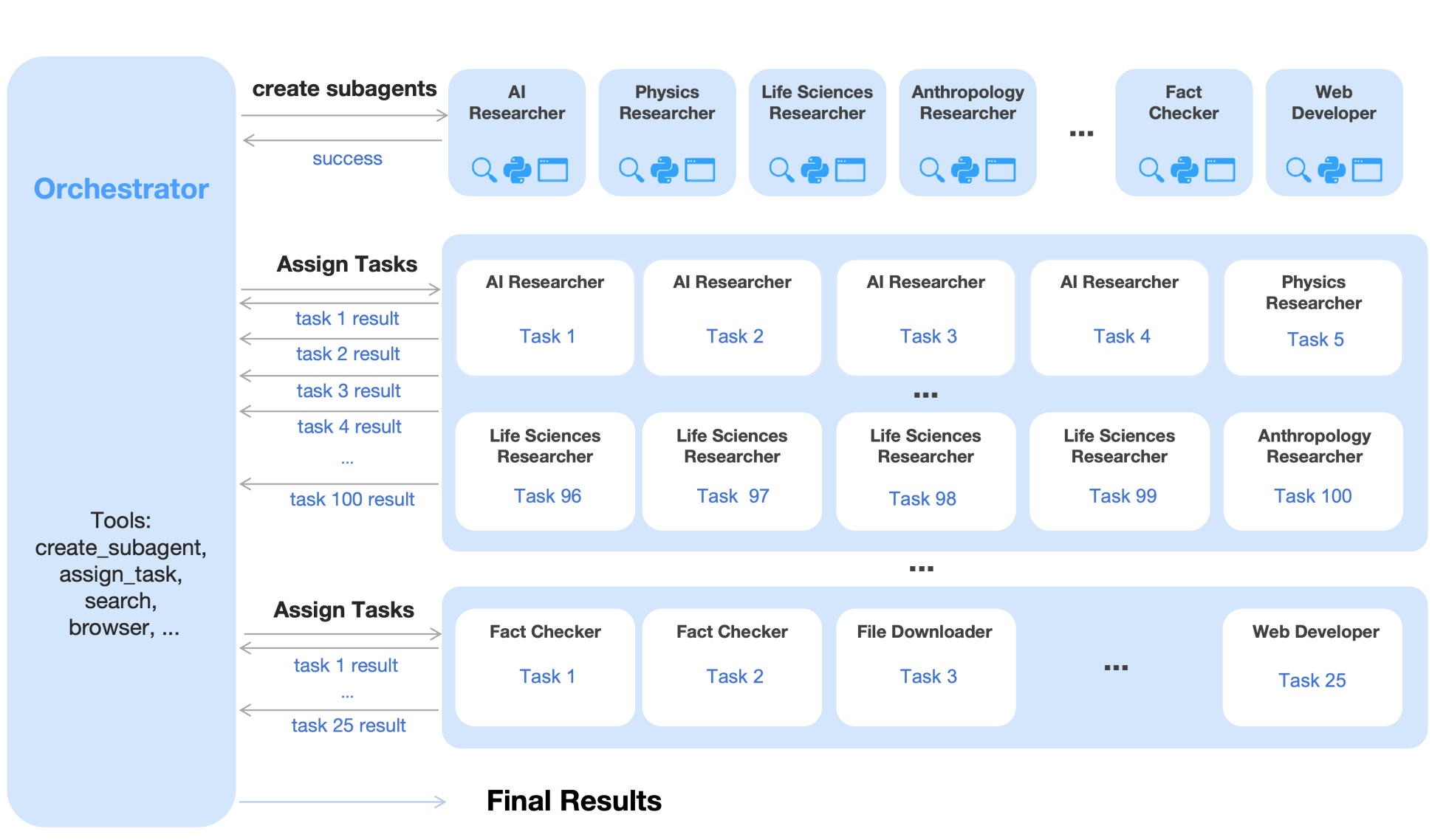
任务含大量独立检索、文件处理或多分支验证时,总 wall time 会近似随 tool steps 线性增长。Agent Swarm 给 orchestrator 两类额外 action:创建带专门任务描述的 subagent,以及等待 / 调度一组已有 subagents。模型自己决定是否拆分、何时并行、最后怎样汇总,而不是执行固定 DAG。
训练架构刻意解耦:
- orchestrator 可训练,接收最终 outcome 与并行辅助奖励;
- subagents 冻结,由固定的中间 policy checkpoint 实例化;
- subagent trajectory 当作 environment observation,不进入 orchestrator 的 differentiable path;
- 先用较小 subagent 训练,再渐进换成较大模型,并动态调节两类 inference instance 的资源比例。
冻结 subagent 降低 non-stationarity 与 credit ambiguity,但也固定了 worker 能力上限。最终成功不证明 每个分支都正确,最终失败也不说明所有分支都错;PARL 学的是 orchestration policy,不是端到端地共同 训练一个多智能体社会。
PARL reward:同时防止 serial collapse 与虚假并行
只给最终任务奖励时,orchestrator 可能收敛到最熟悉的单 agent 路线;只奖励 spawn 数又会创建大量无用 worker。报告定义
\(r_{\mathrm{parallel}}\) 鼓励探索并发调度,避免 serial collapse;\(r_{\mathrm{finish}}\) 奖励 subtask 真正完成,抑制“只创建不使用”的 reward hacking;\(r_{\mathrm{perf}}\) 仍决定最终结果质量。 \(\lambda_1,\lambda_2\) 在训练中退火到零,使最终 policy 回到主要 outcome,而不是永久追求表面并行度。
这种 shaping 仍不能直接奖励“拆得好”。两个 subagent 做重复工作也可能都完成,只有结合 wall time、 结果覆盖、重复率与最终 verifier 才能看出分解质量。
Critical steps:parallel wall time 看最长分支
报告把一次 episode 分成 \(T\) 个 stage。第 \(t\) 阶段 main agent 用 \(S_{\mathrm{main}}^{(t)}\) 步,并同时启动若干 subagent;阶段时长由最长分支决定:
下面的 reference 同时计算 critical path 与 total work,防止把低 latency 误写成低成本:
def step_costs(stages):
    critical = 0
    total = 0
    for main_steps, subagent_steps in stages:
        assert main_steps >= 0 and all(x >= 0 for x in subagent_steps)
        critical += main_steps + max(subagent_steps, default=0)
        total += main_steps + sum(subagent_steps)
    return critical, total

stages = [
    (1, [4, 2, 3]),
    (1, [2, 2]),
    (1, []),
]
critical, total = step_costs(stages)
assert critical == (1 + 4) + (1 + 2) + 1
assert total == (1 + 4 + 2 + 3) + (1 + 2 + 2) + 1
assert critical < total
真实 wall time 还包含 queue、cold start、network、rate limit、merge 与 verification:
而 token、GPU-seconds 与 tool cost 更接近所有分支之和。报告在 WideSearch 的指定 Item-F1 target 上 给出相对 single-agent 的 \(3\times\)–\(4.5\times\) execution-time 改善;它是作者 harness 内的 quality-matched latency 结果,不是任意任务的线性加速定律。
Swarm 也是一种主动 context sharding
串行 agent 会把所有工具输出塞回一个越来越长的 history,再靠 summary、discard-all 或 hide-tool-result 被动压缩。Agent Swarm 在任务执行过程中主动把 history 分散到多个 bounded local context;subagent 独立读写 自己的 working memory,只把 task-relevant result 返回 orchestrator。
因此它可以看成
优点是并行、信息局部性与故障隔离;风险是跨分支依赖、重复搜索、conflicting writes、遗漏中间证据和 汇总瓶颈。若任务是一条强依赖链,spawn 只会增加成本。parallelism 是 policy 应学习的选择,而非默认 美德,正是报告比“固定多 agent 模板”更进一步的地方。
Unified Agentic RL environment
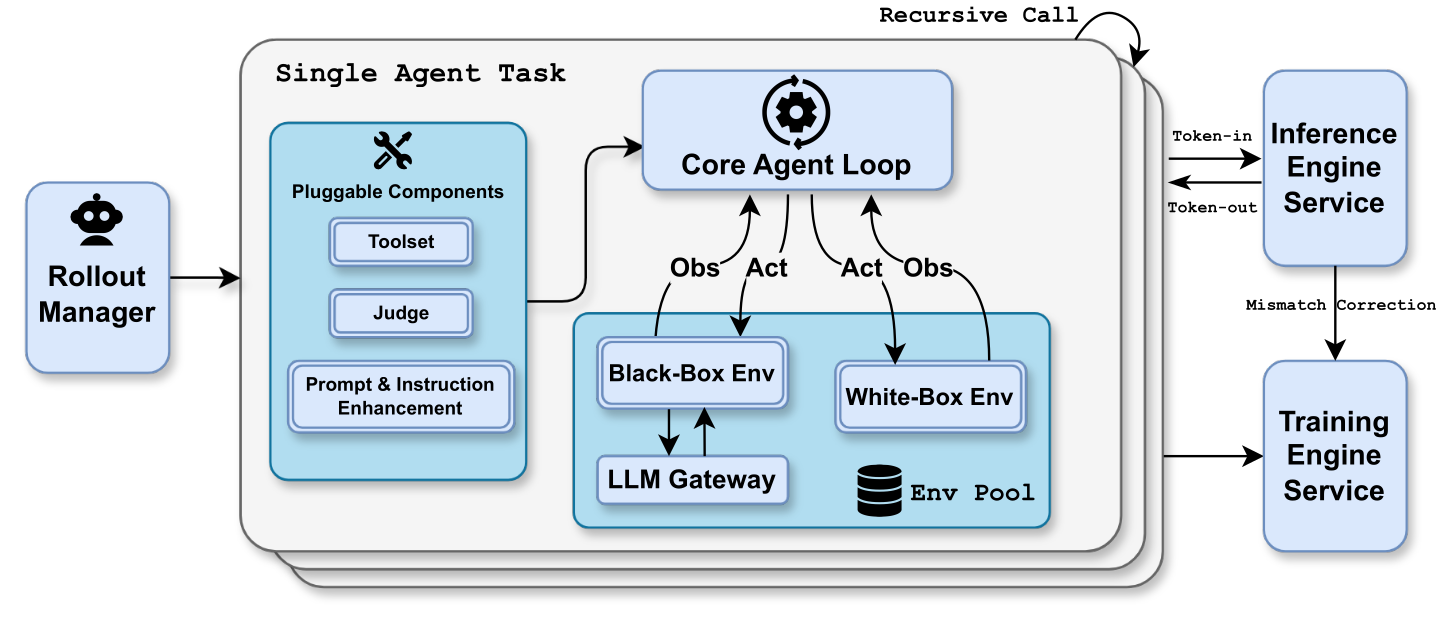
K2.5 把不同任务接到一个 Gym-like contract:
Rollout Manager
  -> prompt / instruction enhancer
  -> core agent loop
  -> pluggable toolset + judge
  -> white-box Env Pool or black-box LLM Gateway
  -> inference engine
  -> token/log-prob record + mismatch correction
  -> training engine
每个 agent task 是独立 async coroutine,并可递归触发 subtask rollout。报告称 Rollout Manager 在作者 系统中最多编排 100,000 个 concurrent tasks;这是系统容量披露,不等于始终同时执行 100,000 次模型 forward,也不说明每项任务的 tool latency 或 token throughput。
white-box environment 能使用定制 inference API、精确记录 log-prob 与环境状态;black-box environment 只有标准 LLM API,LLM Gateway 代为记录 request / response。train-inference mismatch correction 依赖 token-in-token-out 与 rollout log-prob,这也是 agent framework 不能只存最终文本的 原因。相关状态契约见 Agentic RL 训练系统。
评测:单模型、context management 与 swarm 必须分列
报告同时评估 K2.5 单模型与 Agent Swarm。以 agentic search 为例,作者表格给出:
| benchmark | K2.5 Agent Swarm | K2.5 single agent | 口径 |
|---|---|---|---|
| BrowseComp | 78.4 | 60.6 | outcome accuracy;另有 context-management setting |
| WideSearch | 79.0 | 72.7 | Item-F1 |
| in-house Swarm Bench | 58.3 | 41.6 | 内部四域 aggregate |
内部 benchmark 对外不可独立复现;BrowseComp 的 discard-all 与 no-management 也应分开。Swarm 结果还取决于 orchestrator / subagent step limits、并发上限、工具、搜索 API、rate limit 与总成本。 可靠报告至少同时给:
- single-agent 同 checkpoint、同工具、同 quality target 的基线;
- critical steps、total steps、generated tokens、tool calls 与 wall time;
- subagent 数量分布、失败 / 重试、重复工作和 merge cost;
- external benchmark 的 exact version 与 scorer。
视觉评测同样要固定 image resize、frame sampling、最大 visual tokens、thinking mode 与 Python tools。 K2.5 的 image/video-to-code、视觉 reasoning 和长视频结果证明作者系统的广度,却不能仅凭一个 aggregate 分数定位是 encoder、joint data、RL 还是 tool harness 带来的提升。
公开证据的边界
报告公开了架构、stage token 口径、RL 目标、PARL reward、关键系统图和大量 benchmark protocol; 仍未公开完整 pretraining corpus、逐源 mixture、MuonClip 全部超参数、RL prompt set、GRM weights、 PARL \(\lambda\) schedule、10 万任务的集群拓扑或完整训练栈。
官方 checkpoint 可下载也不等于报告每个实验都可复现。尤其需要保留:
- stage headline 与表格 token 总量存在 rounding / denominator 差异;
- cross-modal transfer 是单次作者 run 的观察;
- Agent Swarm speedup 是指定任务和 target quality 下的测量;
- frozen subagent 与 trainable orchestrator 的结论不能外推到 end-to-end multi-agent learning。
K2.5 的持久价值
K2.5 把多模态与 multi-agent 从“额外模块”提升为优化问题:
- early low-ratio fusion 说明模态共适应的时长可能比末期视觉浓度更重要;
- zero-vision SFT 把 representation grounding 与 action grammar 分阶段;
- joint RL 以能力域而非模态域组织训练,但仍需 task-specific verifier;
- PARL 让是否并行成为 policy action,并用 finish reward 与退火抑制投机;
- critical path 与 total work 双账本让 latency 改善不再伪装成成本下降。
继续向前,Kimi K3 把 K2/K2.5 的训练经验接到 KDA、Attention Residuals 与 Stable LatentMoE;回看视觉前史,则应从 Kimi-VL 理解 native-resolution packing、 2D position 与 128K multimodal context。完整家族关系见 Kimi 技术谱系。
Reference
- Kimi K2.5: Visual Agentic Intelligence
- Moonshot AI Kimi K2.5 official technical report, pinned revision
- Moonshot AI Kimi K2.5 official repository and weights
- Kimi K2: Open Agentic Intelligence
- Kimi-VL: Mixture-of-Experts Vision-Language Model
- Patch n' Pack: NaViT, a Vision Transformer for Any Aspect Ratio and Resolution
- YaRN: Efficient Context Window Extension of Large Language Models
- Gym: A Toolkit for Developing and Comparing Reinforcement Learning Algorithms