Attention Residuals:当网络深度也拥有寻址能力
residual connection 通常被解释成梯度高速公路:
但它同时规定了另一件事——下一层怎样读取整个网络历史。展开递推,
所有早期输出都以固定系数 \(1\) 混进同一个 state。梯度可以沿 identity path 直达浅层,深层却只能看到 已经相加后的混合物,不能直接选择“这次重新读取第几层的表示”。
Attention Residuals(AttnRes)把 sequence attention 的思想转到 depth axis:每个 sublayer 用一个 pseudo-query,在 embedding 与此前 sublayer outputs 之间做 softmax retrieval。Full AttnRes 保留逐层来源,Block AttnRes 则以 block summary 换取可控的显存、 pipeline communication 与推理 I/O。
本页从 PreNorm dilution 与多条 residual-generalization 路线出发,推导 Full/Block AttnRes,再进入 online merge、pipeline cache 和 Kimi K3 的系统接入。稳定的架构接口见 注意力与位置。
Residual 的两面:梯度路径与深度聚合
对标准 residual,
展开连乘时始终存在 identity 项,这是深网容易优化的关键。normalization 放在哪一侧,却产生了长期 存在的取舍。On Layer Normalization in the Transformer Architecture 分析了 PostNorm 与 PreNorm 的不同梯度行为:PostNorm 每层重整 residual state,深层梯度更敏感; PreNorm 把 norm 放进 branch,让 identity path 保持干净。
PreNorm 的代价是 residual magnitude 会随层输出累加。AttnRes 论文把其称为 PreNorm dilution:当 \(\lVert h_l\rVert\) 随深度增长,固定尺度的新 branch output 在总 state 中 所占比例下降;深层若要产生同等影响,可能被迫输出更大幅度。这里的核心不是“加法一定数值爆炸”,而是 所有过去被压进一份 state 后,相对贡献与可检索性同时恶化。论文在其 Kimi Linear 实验中观察到 baseline 的 hidden/output magnitude 随深度增长,而 AttnRes 更有界,gradient norm 也更均匀;这是作者配方内 的诊断证据,不是所有 PreNorm 模型的普遍增长定律。
在 AttnRes 之前,大家怎样改 residual
这些工作处理的是不同轴,不能排成简单的替代关系:
| 路线 | 历史状态 | mixing 是否依赖当前输入 | 主要解决的问题 |
|---|---|---|---|
| DeepNet | 单 residual stream | 否 | 用 DeepNorm scale 与初始化稳定极深网络 |
| DenseFormer | 直接保留多层输出 | 否,学习静态 depth weights | 让后层重用远处表示 |
| MUDDFormer | 直接保留多层输出 | 是,且拆分 Q/K/V/residual | 给不同 substream 动态 dense connection |
| Hyper-Connections | \(m\) 个并行 streams | 是,学习 stream mixing | 扩大跨深度 recurrent state |
| mHC | \(m\) 个并行 streams | 是,受 manifold constraint | 恢复 identity 性质并稳定扩展 |
| AttnRes | 逐层或逐 block 来源 | 是,softmax over depth | 显式选择早期表示 |
DeepNet 通过 DeepNorm 的 residual scaling 与配套初始化把 Transformer 扩到 1,000 层;它解决更新尺度与梯度稳定,却仍把历史压在单一递推 state。
DenseFormer 在每个 block 后做 Depth-Weighted-Average,让后层 直接访问此前 representations;权重是训练得到、推理后固定的 scalars,所以不同 token 在同一深度使用 相同 mixing。MUDDFormer 进一步按 token 生成动态 dense weights, 并把 Q、K、V 与 residual stream 分开,表达更细,但连接生成与多路 materialization 也更复杂。
Hyper-Connections 不保存所有历史层,而把 residual state 扩成 \(m\) 个并行 streams,以动态 mixing matrix 读写;mHC 再把 mixing 投影到受约束 manifold,以恢复 identity mapping 并控制大规模训练的不稳定。它们扩大的是递推 state, AttnRes 改变的是访问模式:保留可寻址的历史来源并做 depth-wise softmax。两类机制理论上可以组合, 但 state、I/O 与初始化都会随之改变。
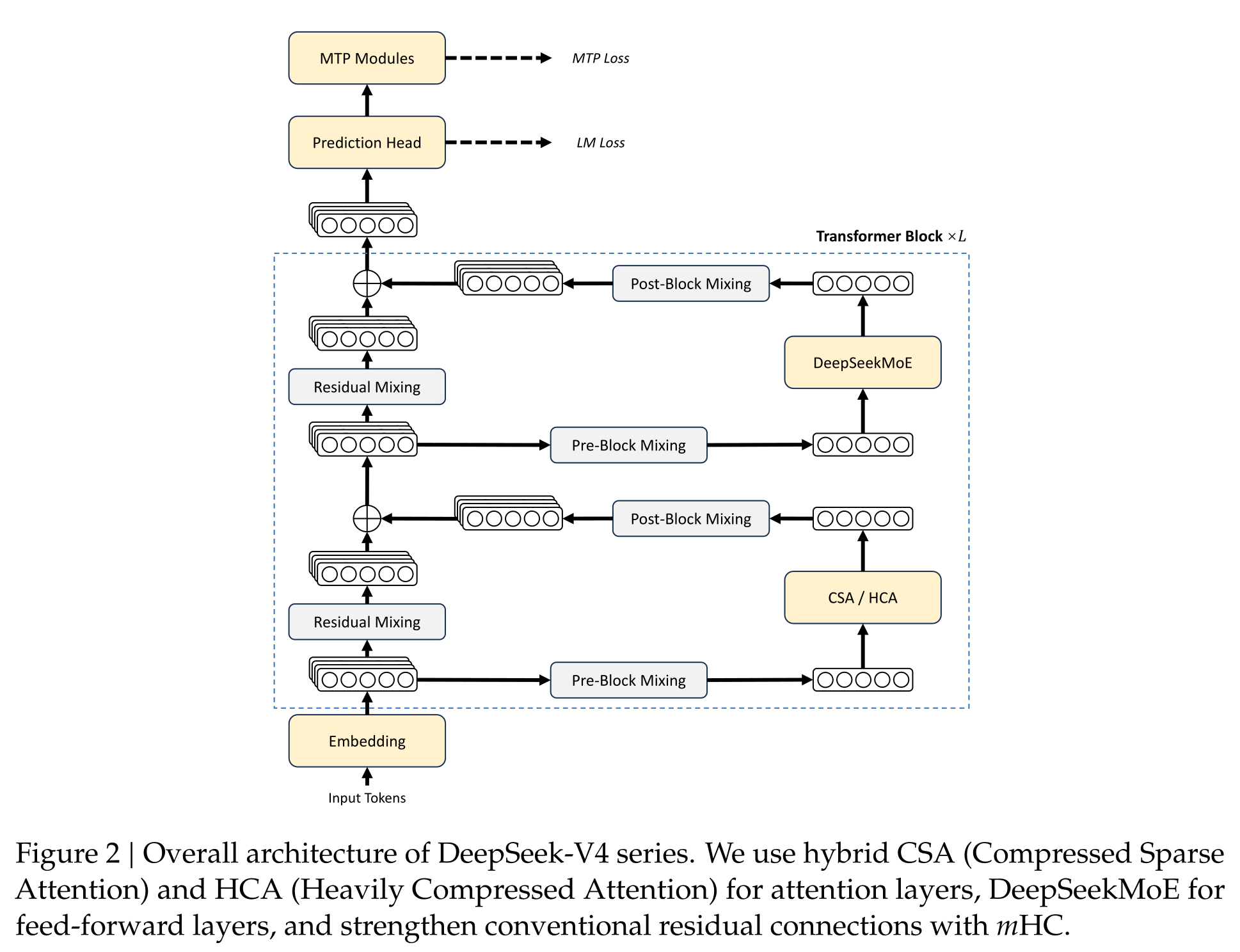
由此可以用两个问题定位一项 residual 方法:
- 它保存一份、\(m\) 份,还是所有历史层的表示?
- 它使用固定系数、输入相关门,还是归一化的竞争式 retrieval?
Full AttnRes:对所有早期层做 softmax
AttnRes 把 self-attention 与 MLP 都视作独立的 layer。令 \(h_1\) 为 token embedding, \(f_i(h_i)\) 为第 \(i\) 个 sublayer output:
第 \(l\) 层只有一个 learnable pseudo-query \(q_l=w_l\in\mathbb R^d\),depth score 为
\(w_l\) 本身不依赖 token;每个 token 的历史表示 \(k_i\) 不同,所以 attention weight 仍是 input-dependent。RMSNorm 防止某层仅凭更大的输出范数占据 softmax,而 values 保留原始尺度。 softmax 还让输入成为历史 outputs 的凸组合,避免 PreNorm 那样必然累加全部幅度。
官方论文要求 pseudo-query 零初始化。训练开始时所有 logits 相等,Full AttnRes 退化成历史来源的均值,先提供平滑对称的路径,再逐步学习选择。随机初始化会在尚未 形成可比较表示时偏爱偶然来源,作者消融中表现更不稳定。
Full form 对 \(L\) 个 sublayers 需要 \(O(L^2d)\) depth-attention arithmetic 与 \(O(Ld)\) live sources。 由于 \(L\) 通常远小于 token length,算术未必昂贵;activation recomputation 与 pipeline parallel 下“这些 source 原本可以释放,现在必须留住并跨 stage 发送”才是主要系统阻力。
Block AttnRes:在精细寻址与状态量之间插值
把 \(L\) 个 sublayers 分成 \(N\) 个 blocks,每块约 \(S=L/N\) 层。第 \(n\) 块的完整 summary 为
块内前 \(i\) 层的 partial sum 记为 \(b_n^i\),并单独保留 \(b_0=h_1\)。第 \(n\) 块第一层只在
上做 depth attention;后续层再加入当前 \(b_n^{i-1}\)。因此跨块保留选择性,块内继续使用便宜的 additive recurrence。
\(N\) 给出连续插值:
- \(N=L\)、每块一层时回到 Full AttnRes;
- \(N=1\) 时块内基本回到标准 residual,只把 embedding 单列为来源;
- 中间值以 block 内细节换取 \(O(Nd)\) live state 与通信。
论文跨规模实验发现约 8 个 blocks 保留大部分 Full gain,但“8”是作者模型与硬件上的经验点,不是 算法常数。block boundary 还决定表示语义:attention/MLP 是否分别计层、最后一块是否不满、embedding 是否始终单列,都必须写进 checkpoint 与 runtime contract。
Online softmax 让两阶段计算保持精确
一个 block 内有 \(S\) 个 pseudo-queries,它们是参数,不依赖前面 layer 的实时输出。于是 inter-block 部分可以先一次性 batch:
- Phase 1 用 \(S\) 个 queries 共同读取已完成的 \(N\) 个 block representations;
- Phase 2 随 layer 顺序更新当前 partial sum,并把这个新来源与 Phase 1 结果合并。
对一组 depth logits 保存
两个不相交 source groups 的 \((m,z,u)\) 可按 online softmax 精确合并,无需重新读取 Phase 1 的 values。
Depth attention 与 online merge reference
下面把 depth/source 轴放在第 0 维。整组计算与任意二分后的 summary merge 应一致;零 query 时则 退化为 source mean。
import torch

def depth_summary(query, sources, eps=1e-6):
    value = sources.float()
    key = value * value.square().mean(-1, keepdim=True).add(eps).rsqrt()
    score = torch.einsum("d,l...d->l...", query.float(), key)
    maximum = score.amax(0)
    weight = torch.exp(score - maximum)
    normalizer = weight.sum(0)
    numerator = (weight[..., None] * value).sum(0)
    return maximum, normalizer, numerator

def merge_summary(left, right):
    maximum = torch.maximum(left[0], right[0])
    left_scale = torch.exp(left[0] - maximum)
    right_scale = torch.exp(right[0] - maximum)
    normalizer = left_scale * left[1] + right_scale * right[1]
    numerator = left_scale[..., None] * left[2] + right_scale[..., None] * right[2]
    return maximum, normalizer, numerator

def finish(summary):
    return summary[2] / summary[1][..., None]

torch.manual_seed(0)
sources, query = torch.randn(7, 2, 3, 5), torch.randn(5)
whole = finish(depth_summary(query, sources))
merged = finish(merge_summary(
    depth_summary(query, sources[:3]), depth_summary(query, sources[3:]),
))
torch.testing.assert_close(merged, whole)
torch.testing.assert_close(finish(depth_summary(torch.zeros(5), sources)), sources.mean(0))
这是 Full AttnRes 的 softmax 真值,也是 Block AttnRes 两阶段 merge 的核心;没有包含 learnable RMSNorm weight、block state machine、output prenorm 或 fused backward。 FLA 的 naive reference 给出了带 norm weights、可选 fused output RMSNorm 与 FP32 math 的当前接口, fused operator 则以 online softmax 和重计算实现 forward/backward。
Pipeline Parallel:缓存的是已知历史
标准 residual 在 pipeline stage 间只传当前 hidden state。Block AttnRes 的后续 stages 需要全部已完成 block summaries;若每次 stage transition 都重传完整历史,会反复搬运相同数据。
对 \(P\) 个 physical stages、每 rank \(V\) 个 interleaved virtual stages,令 \(C=PV\),每 physical stage 平均产生 \(N_p\) 个 block representations。论文给出的每 token 朴素通信量为
同一 physical rank 在后续 virtual stage 会再次需要此前收到的 blocks,因此可把它们留在本地 cache, 只传从上次访问以来新完成的部分:
peak transition 从 \(O(PV)\) 降到 \(O(P)\),论文称其为约 \(V\times\) 改善,并可在 steady-state 1F1B 中与计算重叠。这种 cache 不是模型记忆:它是 pipeline schedule 内、按 micro-batch 隔离的 activation transport cache。micro-batch ID、virtual stage、block completion 和 backward lifetime 任一错位, 都会把另一条样本或另一时刻的 depth sources 喂给当前层。
论文报告,无 pipeline parallel 时 Block AttnRes 训练 overhead 可忽略,在其 pipeline 配置下 end-to-end overhead 小于 4%。这是作者系统的测量;拓扑、block boundary 与 interleaving schedule 变化后要重新计数。
推理:block representations 像一份 depth KV cache
同一 block 内的所有 queries 会重复读取相同已完成 blocks。两阶段调度把 \(S\) 次小读取合成一次 batched inter-block pass,再以便宜的 sequential partial-sum merge 收尾。论文的 per-token、per-layer residual I/O 模型中:
- standard residual 为 \(3d\);
- Full AttnRes 两阶段后为 \((S+N)d\);
- Block AttnRes 为 \((N/S+5)d\)。
在论文示例 \(L=128,N=8,S=16\) 中,Block 为 \(5.5d\),Full 为 \(24d\)。该表只计算 residual mechanism 本身的 read/write,不含 attention、MLP、collective 或 kernel launch。
长 prefill 还要保存每个 token 的 \(N\) 个 block representations,即 \(N T d\) elements。 AttnRes 论文给出的 128K、8-block 例子约 15 GB;沿 sequence axis 分到 8 个 TP ranks 后约 1.9 GB/rank,再以 16K chunked prefill 可降到 0.3 GB 以下。这里分片的 是 token rows,不是把某个 token 的 depth sources 拆散。
Kimi Linear 与 K3 中的接入
原论文先在 Kimi Linear 的 48B total / 3B activated 架构上加入 AttnRes,并用相同配方预训练 1.4T tokens。其 scaling-law 结果中,Block AttnRes 达到同 loss 时, baseline 需要约 \(1.25\times\) compute;最终 48B 对照在作者报告的所有下游项上改善,其中 GPQA-Diamond 为 \(36.9\to44.4\)、HumanEval 为 \(59.1\to62.2\)。这些是单一模型家族和训练分布中的 author-reported evidence,不等同于任意 checkpoint 的无训练替换收益。
16-layer ablation 给出了机制线索:baseline loss 1.766,DenseFormer 1.767,mHC 1.747, Full AttnRes 1.737,block-size 4 的 Block AttnRes 1.746。input-dependent query 变体达到 1.731, 优于默认的 layer-only pseudo-query,却会破坏 queries 可提前 batch 的系统优势;input-independent mixing、移除 RMSNorm、改用 sigmoid kernel 都有不同程度退化。数字说明 softmax、输入相关 keys 与 normalization 在该设置中共同作用,不能只把 gain 归给“更多 skip connections”。
Kimi K3 技术报告进一步把 Block AttnRes 放进 93-layer hybrid KDA/MLA backbone:8 个、每个 12 个 backbone layers 的 blocks,最后一块 允许不满;连同 embedding 有 9 个跨 block sources。K3 的系统接入又做了两层优化:
- prefill 用 sequence-parallel activations,把 TP all-reduce 拆成 reduce-scatter 与 all-gather, 在两者之间对 sequence shard 执行 intra-block merge,避免每个 TP rank 复制所有 block states;
- decode 把 batched inter-block pass 放到 side stream,与 main-stream 工作重叠;intra-block merge、 partial-sum update 与 RMSNorm 则融合进相邻 TP collective。
这些优化依赖 K3 的 block layout、TP/SP 切分与 kernel schedule。只实现论文伪代码,不会自动得到报告 中的 prefill memory 或 decode latency。
公开实现边界
截至 2026-07-28,MoonshotAI/Attention-Residuals 公开的是论文、图表与 PyTorch-style Block AttnRes pseudocode,没有完整训练栈、K3 pipeline cache 或生产推理 kernel。FLA 主分支已经提供 naive 与 fused AttnRes operators,并测试 source count、 hidden width、dtype、forward/backward、可选 output RMSNorm 等组合;它实现的是 depth-softmax 算子核心,不等于论文中完整的 block orchestration 与跨 stage cache。
因此复现应分三层:
- 语义层:source 顺序、embedding、partial block、RMSNorm 与 softmax axis;
- 算子层:FP32 reference、fused forward/backward、online merge 与重计算;
- 系统层:checkpointing、PP cache、SP/TP collective、side stream 与 block state lifetime。
“官方仓库存在”只能证明第一层伪代码和论文资产已经公开;“FLA 有 fused op”也不能证明第三层已被 开源复刻。
尚未解决的问题
- Full 还是 Block:更细 source 提高选择能力,却增加 live state 与通信;硬件变化会移动最优点。
- block boundary:固定等长切块未利用 attention/MLP 类型、层功能或 learned routing 的差异。
- query 条件化:input-dependent query 在论文消融更好,但会失去提前 batch 的关键系统性质。
- source collapse:softmax 是否长期只选 embedding、当前 partial 或少数中层,需要按 token/任务分析。
- checkpoint migration:零 query 产生平均而非标准 residual sum,不能无损加载已有 PreNorm 权重。
- 与 mHC 组合:多 streams 与可寻址历史可能互补,也可能把 state/I/O 成本相乘。
- 训练外深度:AttnRes 没有证明模型可以像 length extrapolation 那样直接增加 layers。
- 因果解释:depth weight 可视化显示读取偏好,但不自动构成某层功能的因果证明。
验证时至少覆盖:零初始化首步、source permutation、Full/Block 极限、online merge、block 尾部、 activation recompute、不同 PP/VP schedule、prefill/decode 对齐、forward/backward 误差,以及训练中 每层 output magnitude、gradient norm、attention entropy 与 source occupancy。
Reference
- On Layer Normalization in the Transformer Architecture
- DeepNet: Scaling Transformers to 1,000 Layers
- DenseFormer: Enhancing Information Flow in Transformers via Depth Weighted Averaging
- Hyper-Connections
- MUDDFormer: Breaking Residual Bottlenecks via Multiway Dynamic Dense Connections
- mHC: Manifold-Constrained Hyper-Connections
- Attention Residuals
- MoonshotAI/Attention-Residuals
- Online Normalizer Calculation for Softmax
- Kimi Linear: An Expressive, Efficient Attention Architecture
- Kimi K3 Technical Report
- FLA AttnRes Naive Reference
- FLA Fused AttnRes Operator