Off-policy 校正:当数据不是由当前策略产生
On-policy 推导假设轨迹来自正在优化的策略;真实系统却常把 rollout 与 learner 解耦,复用 replay,或让许多推理 worker 使用稍旧的 checkpoint。此时 behavior policy \(\mu\) 负责产生数据,target policy \(\pi\) 才是要评估或优化的对象。
Off-policy correction 试图修正这两个分布之间的差异,但不存在把任意旧轨迹“无损变新”的技巧。importance sampling 无偏却可能高方差;截断权重降低方差又引入偏差;分布支持已经丢失时,任何重加权都无法恢复未采到的动作。
先读 Policy Gradient 理解 on-policy estimator,再读 Actor–Critic 理解 value target。本页最后把经典 importance sampling、V-trace 与异步 LLM/Agentic RL 的版本契约连起来。
Behavior 与 target policy
设轨迹由
产生,而目标是估计或优化 \(\pi\)。单步 importance ratio 为
只要 \(\mu(a\mid h)>0\) 覆盖所有 \(\pi(a\mid h)>0\) 的动作,就有
整条轨迹的权重则是 ratio 乘积:
长轨迹中,即使每个 \(\rho_t\) 只略偏离 \(1\),乘积也可能指数级变大或趋近零。这是 off-policy 长程语言 agent 特别困难的原因:一次 episode 可包含成百上千个 token 和多次环境转移。
Per-decision importance sampling
估计折扣回报时,无须让早期 reward 乘上未来动作 ratio。Per-decision IS 写成
它利用因果结构减少不必要的乘积,但方差仍随 horizon 增长。Self-normalized IS 可把权重除以 batch 权重和,通常更稳定,却不再严格无偏,并且 batch composition 会影响每个样本的有效权重。
因此工程上还会采用:
- 截断 \(\rho_t\) 或轨迹总权重;
- 限制 replay 年龄与 policy lag;
- 只保留新旧策略重叠良好的 token;
- 使用 learned value bootstrap 缩短乘积;
- 直接丢弃无法可靠校正的轨迹。
每一种都在样本效率、方差和偏差之间重新取舍。
V-trace
IMPALA 面对许多 actor 落后于 learner 的场景,使用截断 importance weight 构造 value target。定义
带校正的 TD residual 为
从位置 \(s\) 开始的 V-trace target:
actor 可使用
\(\bar\rho\) 主要控制目标 policy 的校正强度,\(\bar c\) 控制多步信息向前传播的方差。截断让 estimator 更稳定,也把 fixed point 推向由 \(\pi\)、\(\mu\) 和截断共同定义的策略;它不是“数值上更稳但完全等价”。
一个紧凑的 V-trace target
import torch
@torch.no_grad()
def vtrace(reward, value, logp, behavior_logp, terminated,
           gamma=0.99, rho_bar=1.0, c_bar=1.0):
    aligned = (logp.shape == behavior_logp.shape == terminated.shape == reward.shape)
    if reward.ndim != 2 or not aligned or value.shape != (reward.size(0), reward.size(1) + 1):
        raise ValueError("transition tensors and bootstrap value must align")
    if terminated.dtype != torch.bool:
        raise ValueError("terminated must be boolean")
    ratio = (logp - behavior_logp).exp()
    rho, c = ratio.clamp(max=rho_bar), ratio.clamp(max=c_bar)
    bootstrap = ~terminated
    next_value = torch.where(bootstrap, value[:, 1:], 0.)
    delta = rho * (reward + gamma * next_value - value[:, :-1])
    target = torch.empty_like(reward)
    carry = value[:, -1]
    for t in range(reward.shape[1] - 1, -1, -1):
        correction = torch.where(
            bootstrap[:, t], c[:, t] * (carry - value[:, t + 1]), 0.)
        carry = value[:, t] + delta[:, t] + gamma * correction
        target[:, t] = carry
    next_target = torch.cat([target[:, 1:], value[:, -1:]], dim=1)
    next_target = torch.where(bootstrap, next_target, 0.)
    advantage = rho * (reward + gamma * next_target - value[:, :-1])
    return target, advantage, ratio
reward = torch.tensor([[1.0, 2.0]])
value = torch.tensor([[0., 0., float("nan")]], requires_grad=True)
terminated = torch.tensor([[False, True]])
target, advantage, ratio = vtrace(
    reward, value, torch.zeros_like(reward), torch.zeros_like(reward),
    terminated, gamma=1.0
)
torch.testing.assert_close(target, torch.tensor([[3.0, 2.0]]))
torch.testing.assert_close(advantage, torch.tensor([[3.0, 2.0]]))
assert torch.isfinite(target).all() and not target.requires_grad and not advantage.requires_grad
这段代码没有处理 padding。调用方必须使每条 batch row 的有效 transition 连续,或在递推中加入单独的 valid-step mask;把 padding reward 设零仍会让 value 和 c 穿过伪时间步传播。
importance sampling、截断权重与极端 ratio 的组合实验见手撕:强化学习。
Retrace、ACER 与不同校正目标
V-trace 不是唯一选择:
- Retrace(\(\lambda\)) 用截断 ratio 与 eligibility trace 构造安全、低方差的 action-value target;
- ACER 把经验回放、截断 IS 与 bias correction 结合到 actor–critic;
- off-policy policy gradient 直接在 behavior state distribution 下推导目标,但优化口径不同于原始 on-policy performance;
- PPO-style clipping 限制 policy update,却不能单独修复任意 policy lag。
选择方法前要先明确校正对象:是 value evaluation、policy gradient、整条 sequence likelihood,还是异步系统中“哪些 token 仍可消费”。把不同论文里的 clip 常数拼在一起,不会自动形成一致 estimator。
LLM rollout 的真实 behavior distribution
语言模型系统常只保存 checkpoint 名称,然后用该 checkpoint 重新计算 old log-prob。这不足以重建 behavior policy,因为实际采样还依赖:
tokenizer and chat template
temperature
top-k / top-p / typical sampling
repetition and length processors
grammar or tool-schema masks
precision, quantization and inference kernel
adapter set
random-number implementation
若 token 从 top-\(p\) 截断分布采样,\(\mu\) 可以指截断后的归一化分布,也可以指 processor 前的基础模型分布;两种 ratio 对应不同目标。必须保存或明确重建实际采样概率,不能在更新时静默切换口径。
工具 observation 不是 policy action,不应有 importance ratio;assistant 生成的工具名、参数或文本才属于动作。若一次工具调用按 span 视为动作,则
长 span 的 ratio 更容易极端。改成 token 平均 log-ratio 会改善尺度,却改变 estimator,应作为独立算法选择记录。
Policy lag 不只是版本号之差
异步系统中,behavior checkpoint 为 \(v_b\),learner 当前 checkpoint 为 \(v_l\)。v_l-v_b 只能粗略表示 lag;两次小更新可能比一次大更新更接近,也可能相反。更有意义的诊断包括:
- action token 上的 current/behavior KL;
- log-ratio 的 p50、p95、p99 与极值;
- 被截断、丢弃或降权的 token/sequence 比例;
- 按任务、长度、worker 与环境类型分层的 lag;
- 轨迹从生成、验证、排队到消费的 wall-clock age;
- 更新后 reward、success 与独立评测是否随 lag 退化。
系统应给数据设新鲜度预算。高方差校正不如直接重新 rollout 时,丢弃旧数据是正确选择,不是样本浪费。轨迹需要保存的不可变字段见轨迹与策略契约,rollout–learner 调度见训练系统。
与 PPO、SAO 的边界
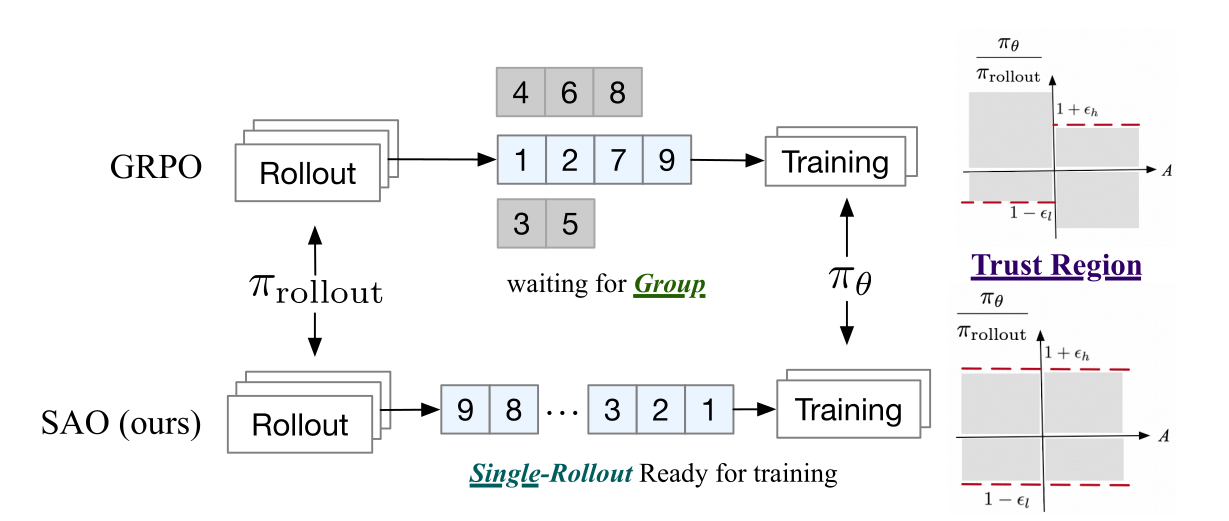
Trust Region 与 PPO 通常假设一批轨迹由冻结的 \(\pi_{\text{old}}\) 产生,再做有限次更新。异步系统打破的是“采完再学”的整齐边界:
worker samples under behavior v_b
  -> environment / verifier latency
  -> queueing
  -> learner already at v_l
  -> correction, filtering or discard
AReaL 等系统工作把 staleness 视作一等指标;SAO 则针对长尾 Agentic rollout,保存真实 behavior log-prob,并用双侧 importance 区间选择仍可用于更新的 token。详细方法与实验边界见 SAO 与 CompactionRL。这类筛选提高异步吞吐,但被丢弃的 tail 可能产生选择偏差,critic 也需要跟上新策略。
实现契约
target and behavior policy immutable revisions
actual sampled action IDs and behavior log-probabilities
sampling processor and probability convention
ordered transition, action and valid-step masks
terminal versus truncation bootstrap semantics
rho/c clipping thresholds and estimator definition
trajectory age, update lag and replay count
discard/downweight reason for every rejected sample
最小验证:
- \(\pi=\mu\) 时所有 ratio 为 \(1\),V-trace 退化为普通多步 TD target;
- 一步真正终态不读取边界 value;
- truncation 可保留明确提供的 bootstrap value;
- 人工构造极大、极小 ratio,检查 clip 与 bias 方向;
- 改变 observation token 的 log-prob 不影响 policy correction;
- 按 lag bucket 重跑固定评测,而不只比较训练 reward。
失败边界
- support 不重叠:behavior 从未采到的动作不能靠重加权恢复。
- 重算 behavior log-prob:模板、processor 或 kernel 漂移会产生虚假 ratio。
- 长序列 ratio 连乘:数值下溢只是表象,统计方差同样爆炸。
- clip 被写成无偏校正:截断明确引入偏差。
- PPO clip 替代 off-policy 分析:有限更新约束不能修复任意陈旧数据。
- 版本差替代分布差:checkpoint ID 距离不等于 KL。
- padding 穿过递推:伪 transition 污染 value target。
- 基础设施失败记作低 reward:策略被训练去回避机器故障。
- 只报告吞吐提升:更旧的数据可能换来更差的有效学习率与最终能力。
历史位置
Importance sampling 为不同策略间的期望转换提供了数学起点,但长轨迹暴露了它的方差极限。Retrace、ACER 和 V-trace 逐步把截断校正、bootstrap 与分布式 actor–learner 结合起来。LLM 与 Agentic RL 把同一问题推到更长序列、更昂贵环境和更复杂采样器上:系统吞吐与统计新鲜度必须一起优化。
GLM-5:ratio gate、版本 gate 与故障 gate
GLM-5 的异步管线没有尝试用一个 importance ratio 解决所有偏差,而是分三层处理:
| 层 | 判据 | 动作 | 未解决的问题 |
|---|---|---|---|
| token | direct ratio 超出双侧区间 | mask token 梯度 | 状态分布偏差 |
| trajectory | 当前版本与最旧 behavior revision 差超过 \(\tau\) | 丢弃样本 | 版本差不等于分布差 |
| environment | sandbox collapse 等基础设施故障 | 排除样本 | 故障识别可能误判 |
组内过滤后,有效样本超过一半就用有效轨迹重复补齐,否则删除整组。这个策略维持 batch shape,却会提高幸存轨迹的权重;必须把 duplication rate 与 reward 一起报告。实现语义见 slime 与异步 Agentic RL。
Reference
- Degris, White, and Sutton, Off-Policy Actor-Critic
- Munos et al., Safe and Efficient Off-Policy Reinforcement Learning / Retrace
- Wang et al., Sample Efficient Actor-Critic with Experience Replay / ACER
- Espeholt et al., IMPALA: Scalable Distributed Deep-RL with Importance Weighted Actor-Learner Architectures
- Fu et al., AReaL: A Large-Scale Asynchronous Reinforcement Learning System
- GLM-5: from Vibe Coding to Agentic Engineering