推理策略优化:从 PPO 到异步 Agentic RL
大模型推理 RL 的演进不是一串 optimizer 缩写。每一轮新方法都在移动同一组物理约束:终局 reward 很稀疏,response 越来越长,critic 难以追踪,组采样会等待最慢候选,推理与训练引擎又未必实现同一个概率分布。
要看清这条历史,先把一个 trainer 拆成六个可以独立变化的对象:
feedback
  -> sampling
  -> advantage / credit
  -> policy-update geometry
  -> loss reduction
  -> rollout-learning system
GRPO 主要改变 advantage;DAPO 同时改变 gate、sampling、reduction 与 reward;VAPO 重新设计 critic 和 GAE;GSPO、SAPO、CISPO 改变 ratio/gate;TIS、IcePop、DIS 则处理 rollout distribution 与训练分布的裂缝。方法名字只有放回这些坐标后才有历史意义。
2015–2017:先解决“怎样迈一小步”
GAE 把多步 TD residual 指数加权,给 actor–critic 一条可调的 bias–variance 轴:
TRPO 则从 performance-difference 与 KL 邻域出发,限制新策略离 old policy 太远。PPO 用 clipped first-order surrogate 换取 minibatch SGD 和更简单的分布式实现。
这三项工作形成后来 LLM RLHF 的经典骨架:
rollout under behavior policy
  -> freeze / recompute old training log-prob
  -> learned reward / environment return
  -> critic + GAE
  -> clipped policy update
  -> optional reference KL
其稳定性来自一组联合契约,而不是 clip 一项:old log-prob 必须冻结,critic target 要正确处理 terminal/truncation,同一 rollout 的复用 epoch 不能无限增加,KL、ratio tail 与 value drift 都要观察。完整机制分别见 Advantage 与 GAE、Trust Region 与 TRPO 和 PPO。
2017–2022:PPO 进入语言模型闭环
人类偏好研究把 reward 从环境函数变成 learned model。InstructGPT 把 demonstrations、pairwise reward model、PPO 与 reference/pretraining constraint 组织成三阶段流程。
语言模型把经典 PPO 推到一个特殊场景:
- 一次“动作”可以按 token、response 或 turn 定义;
- reward 常在 sequence 末端一次给出;
- action space 是巨大词表,但只对 sampled token 计算 surrogate;
- rollout 远比普通反向传播昂贵;
- current、old training、rollout behavior 与 reference policy 同时存在。
这时,value model 的必要性与成本都更加突出。它能把终局 reward 分解为 prefix advantage,却也需要另一份大模型参数或 head、额外优化器状态和不断追踪 current policy 的数据。
2024:GRPO 把 baseline 搬到同题候选之间
DeepSeekMath 提出 GRPO:对同一个数学 prompt 采样 \(G\) 个 response,用组均值和标准差构造优势,省去同规模 critic。
这个选择把困难从 value learning 转移到 group sampling:
不再训练 critic
  -> 每个 prompt 需要多个 rollout
  -> 必须等待同组候选
  -> 全同 reward 组没有相对信号
  -> group std 与 response length 进入权重
与此同时,Back to Basics 重新评估 REINFORCE、RLOO 与 PPO,提醒研究者:简单的 leave-one-out baseline 在某些 sequence-reward RLHF 设置中已经很强。无 critic 并不是 GRPO 的专属属性,组标准化也不是唯一选择。
GRPO 随 DeepSeek-R1 进入更大的公众视野,但 R1 的能力来自规则 reward、cold start、在线 RL、rejection sampling、二次 SFT/RL 与 distillation 的多阶段组合。把这条路线缩写为“GRPO 产生 reasoning”,会把数据与训练闭环全部抹掉。
2025 年初:先审计看似无害的分母
Understanding R1-Zero-Like Training 提出 Dr. GRPO,指出原 GRPO 中两种权重:
- group std 使不同 prompt 按 reward dispersion 重权;
- response token mean 使每个 token 的权重与 \(1/|y_i|\) 成正比。
Dr. GRPO 去掉 group std,并用固定生成预算作归一化。这项工作推动了一个重要认识:LLM policy loss 的分母不是工程细节,而是经验目标的一部分。
同一 per-token surrogate 可以按三种方式归约:
它们分别让 response、有效 token 或固定预算成为权重单位。训练结果若不同,不能只归因于 optimizer 名称。
2025 年春:DAPO 把失败模式变成开放配方
DAPO 从 naive GRPO 的训练失败出发,引入四项联合改动:
- asymmetric Clip-Higher;
- 只保留 mixed group 的 dynamic sampling;
- global token-level loss;
- overlong filtering 与 soft punishment。
它的历史意义有两层。第一,方法不再只发布一个漂亮的 objective,而是公开数据、代码、模型和系统 recipe;第二,四项改动明确落在不同抽象层:
| 失败 | 改动 |
|---|---|
| 低概率正 token 很快上裁剪 | Clip-Higher |
| 全对/全错组稀释有效 batch | Dynamic Sampling |
| 长 response 的每 token 权重过小 | Global Token Loss |
| generation limit 制造 noisy negative | Overlong Handling |
DAPO 的成功不能证明 dynamic sampling 本身是新 optimizer,也不能证明 global token mean 没有长度倾向。它说明的是:长 CoT RL 的稳定性必须把算法、采样、reward 与 reduction 一起看。
2025 年春:VAPO 没有继续“去 critic”
VAPO 选择了另一条分支。它观察到 value-based PPO 在长 CoT 中的三个问题:
- reward-model initialization 对 prefix value 有偏;
- 固定 \(\lambda\) 让终局 reward 在长序列中过度衰减;
- 稀疏 verifier reward 使正确 response 极其珍贵。
因此 VAPO 先 warm up value model,让 critic target 使用 \(\lambda_{\mathrm{critic}}=1\),让 actor 使用
再组合 Clip-Higher、global token loss、positive-example NLL 与 group sampling。
这条分支很有历史感:GRPO 曾以组统计替代 critic,VAPO 又在更长信用路径上把 critic 带回来。不是后一种“退回旧算法”,而是任务约束改变了成本比较:
2025 年中后:ratio 的粒度成为主战场
当 advantage 与 sampling recipe 越来越成熟,研究焦点转向 sampled probability ratio 本身。
CISPO:clip weight,不把梯度清零
MiniMax-M1 中的 CISPO 将 clipped importance ratio detach 后乘在 \(\log\pi\) 前。越界 token 的权重饱和,但梯度不归零。它与 PPO 的区别不在 clip 数值,而在 clip 作用于 surrogate 还是 detached gradient coefficient。
GSPO:整条 response 共用 ratio
GSPO 使用
让整条 response 共用一个 sequence-level clip decision。它避免 token 间 update coherence 被打散,却可能因少数异常 token 让整条 response 饱和。\(s_i\) 是 trajectory ratio 的长度归一化几何平均,不是普通 trajectory IS weight。
SAPO:从硬门变成平滑门
SAPO 用 sigmoid surrogate 让远离 \(\rho=1\) 的梯度平滑衰减,并为正负 advantage 采用不同温度。它不在阈值处突然归零,却仍要面对 engine mismatch、policy lag 和 reduction 选择。
这些方法的统一公式、梯度与边界见 Ratio、Clipping 与 Gate。
2025:训练引擎与推理引擎不再被假定相同
大规模 trainer 常用 vLLM/SGLang 一类推理引擎 rollout,用 FSDP/Megatron 一类训练栈反向传播。即使权重相同,量化、kernel、并行归约、MoE routing 与 sampling processor 都可能让两边 token probability 不同。
于是 PPO ratio
不再足以描述真实 behavior。还需要
On the Rollout-Training Mismatch 用 TIS 截断 \(\kappa\);Every Step Evolves 中的 IcePop 在可信区间内校正、区间外 mask;R3 则为 MoE 记录并重放 rollout routing。
它们修的是 engine distribution,不是 PPO trust region。把 TIS cap 当作另一个 PPO epsilon,会混合两条完全不同的分布缝隙。
2026:长程 Agent 把时间与空间瓶颈推到前台
单轮 reasoning 的 response 再长,通常仍是一个 prompt 后的自回归生成。Agentic RL 增加:
- 环境 observation 与工具结果;
- 数百轮真实状态转移;
- 极端重尾的 episode 时长;
- rollout 与 learner 的异步队列;
- 超出 context window 的历史。
SAO 与 CompactionRL 分别沿时间、空间两条轴处理这些约束。
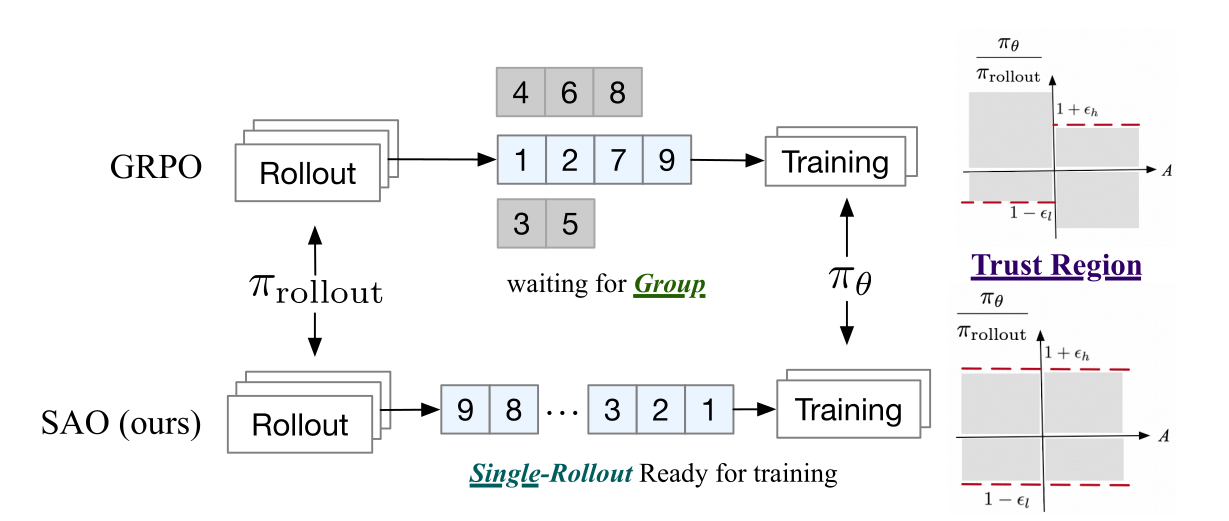
SAO 让每个 prompt 只采一条 trajectory,完成后立即进入异步 learner;critic 提供 token/step advantage,DIS 直接比较 current training policy 与 rollout behavior,并用双侧 gate 拒绝 mismatch tail。它用 critic 与分布治理换取不再等待同组候选。
CompactionRL 让 policy 学会生成摘要,并把摘要视作会影响后续状态的 action;训练还要修复 segment 切分导致的 token normalization 与跨段信用。
这时,“PPO 还是 GRPO”已不是完整问题。还要问:
谁产生 behavior probability
哪类 token 是 action
一个 GAE step 对应 token、turn 还是 segment
旧轨迹能滞后多少
context compaction 是否改变环境状态
一张正交坐标图
这些方法更像从多个接口装配出的配方,而不是一棵后者取代前者的版本树:
feedback      human / AI / reward model / verifier
sampling      single rollout / prompt group / dynamic or filtered sampling
advantage     return / learned V + GAE / RLOO / group statistics
update        PPO clip / Clip-Higher / CISPO / GSPO / SAPO / DIS
reduction     response mean / global token mean / fixed budget
distribution  on-policy / policy lag / engine mismatch
system        synchronous barrier / asynchronous actor–learner
因此 PPO 常与 learned critic 和 GAE 组合,却不在定义上绑定某个 advantage estimator;GRPO 选择 group-relative advantage,通常仍使用 PPO-style update;DAPO 同时改 sampling、gate、reduction 与 overlong handling;VAPO 用 critic/GAE 构造 advantage,又吸收 DAPO 的 Clip-Higher 与 token loss。CISPO、GSPO 与 SAPO 主要改变 update geometry,论文中常配 group advantage,但不是 GRPO 的算法子孙。
怎样读下一篇新论文
面对一个新缩写,先填一张空表:
| 轴 | 必须找到的答案 |
|---|---|
| Feedback | reward 来自谁,验证了什么 |
| Sampling | 每 prompt 几条,如何筛选,花了多少 token |
| Advantage | critic、return、RLOO、group std 还是别的 estimator |
| Ratio | current/old、train/rollout 还是 current/behavior |
| Gate | surrogate、detached coefficient、smooth gate 还是 hard mask |
| Reduction | token、response、prompt、trajectory 或固定预算 |
| System | 同步、流水还是异步,staleness 如何控制 |
| Evidence | 哪个模型、数据、budget、baseline 与独立评测 |
若一篇工作只改其中一格,就不应把整个 trainer 收益归给它;若同时改多格,也不能把它压成单一公式。对应的横向选择入口见推理 RL 配方地图,可运行张量语义见手撕 LLM 策略优化。
Reference
- Schulman et al., High-Dimensional Continuous Control Using Generalized Advantage Estimation
- Schulman et al., Trust Region Policy Optimization
- Schulman et al., Proximal Policy Optimization Algorithms
- Shao et al., DeepSeekMath: Pushing the Limits of Mathematical Reasoning in Open Language Models
- Liu et al., Understanding R1-Zero-Like Training: A Critical Perspective
- Yu et al., DAPO: An Open-Source LLM Reinforcement Learning System at Scale
- Yue et al., VAPO: Efficient and Reliable Reinforcement Learning for Advanced Reasoning Tasks
- Zheng et al., Group Sequence Policy Optimization
- Gao et al., Soft Adaptive Policy Optimization
- Qwen Team, Stabilizing Reinforcement Learning with LLMs: Formulation and Practices
- Hou et al., Single-Rollout Asynchronous Optimization for Agentic Reinforcement Learning